How to give useful logo feedback within revision rounds

A revision round works better when your team sends one clear list tied to the brief and a named version. Use this guide to turn vague opinions into useful feedback, resolve conflicting instructions and approve the final logo precisely.
In this guide
Define a revision round before you use it
For a logo project, agree whether one revision round means one consolidated set of feedback followed by one revised presentation. That is a useful working definition, not a universal industry rule. The proposal should also explain what happens when feedback changes the approved name, concept or deliverables.
Biaway's starter-branding catalogue, reviewed on 15 October 2026, lists up to two revision rounds within its SAR 500 one-time package. It does not mean unlimited new concepts or unlimited messages until every stakeholder is satisfied. Confirm how rounds are collected, which person approves them and how additional work is handled before starting.
A correction to something that fails the agreed brief is different from a new preference or an added requirement. Record the issue accurately and ask the provider how the agreement handles it; do not quietly label every correction as a new paid round, or assume every change is automatically included.
References: Biaway: starter-branding package and revision allowance
Turn opinions into a short, actionable feedback register
Useful feedback identifies the version, the place where the problem appears, the business reason and the desired outcome. It can leave the visual solution to the designer. 'The Arabic name becomes hard to read in our profile crop' is more actionable than 'Make it pop' because it describes a testable problem.
Use this original register to separate a correction, a refinement and a potential scope change. The classification is a discussion aid, not a substitute for the agreed terms. Resolve conflicting instructions inside your team before sending the final list.
Scroll the table sideways to read every column.
| Initial comment | Useful feedback | Decision needed |
|---|---|---|
| The name looks wrong | Version 02 omits a letter from our approved Arabic spelling; compare the attached wording sheet | Correct the mismatch against the agreed brief |
| Make it bigger | At the actual profile size the symbol is readable but the descriptor is not; test the agreed compact version | Refine the application without changing the name |
| Use blue instead | Our approved direction was burgundy, but the owner now wants a blue identity across all assets | Confirm the change of direction and its effect on scope |
| Add English too | The original scope listed an Arabic mark; we now need a combined Arabic/English lockup | Agree the added language deliverable before execution |
| Something feels off | The quotation cover gives the symbol more emphasis than the business name; please improve the hierarchy | Review a defined reading problem in a real application |
Use the first round for direction and the next for refinement
A practical two-round review plan begins by checking the design against the brief, not by asking everyone which version they personally like. In the first round, settle the chosen direction, the legibility of both names where included, and major problems in the intended applications. Keep comments tied to the audience and use cases already agreed.
In the next round, review the revised work against the first list and address remaining detail: spacing, a specific colour application, a compact variant or a missed correction. If the team now wants an entirely different concept, pause and discuss scope instead of pretending it is a small adjustment.
This sequence is a suggested way to organise a project, not a rule that every designer must use or a promise about the number of initial concepts. Ask the provider to confirm its own review process and calendar. Timelines should allow for the owner's language review and approval, not just the designer's working time.
- Before the presentation, confirm the brief, approved wording, required variants and acceptance criteria.
- Nominate one person to gather comments from the owner and language reviewers.
- Send one numbered list linked to the exact presentation version, with an agreed priority for each issue.
- On the next presentation, mark each item resolved, still open or changed by a new requirement.
- Approve the final artwork explicitly, then check the delivered files against that approved version.
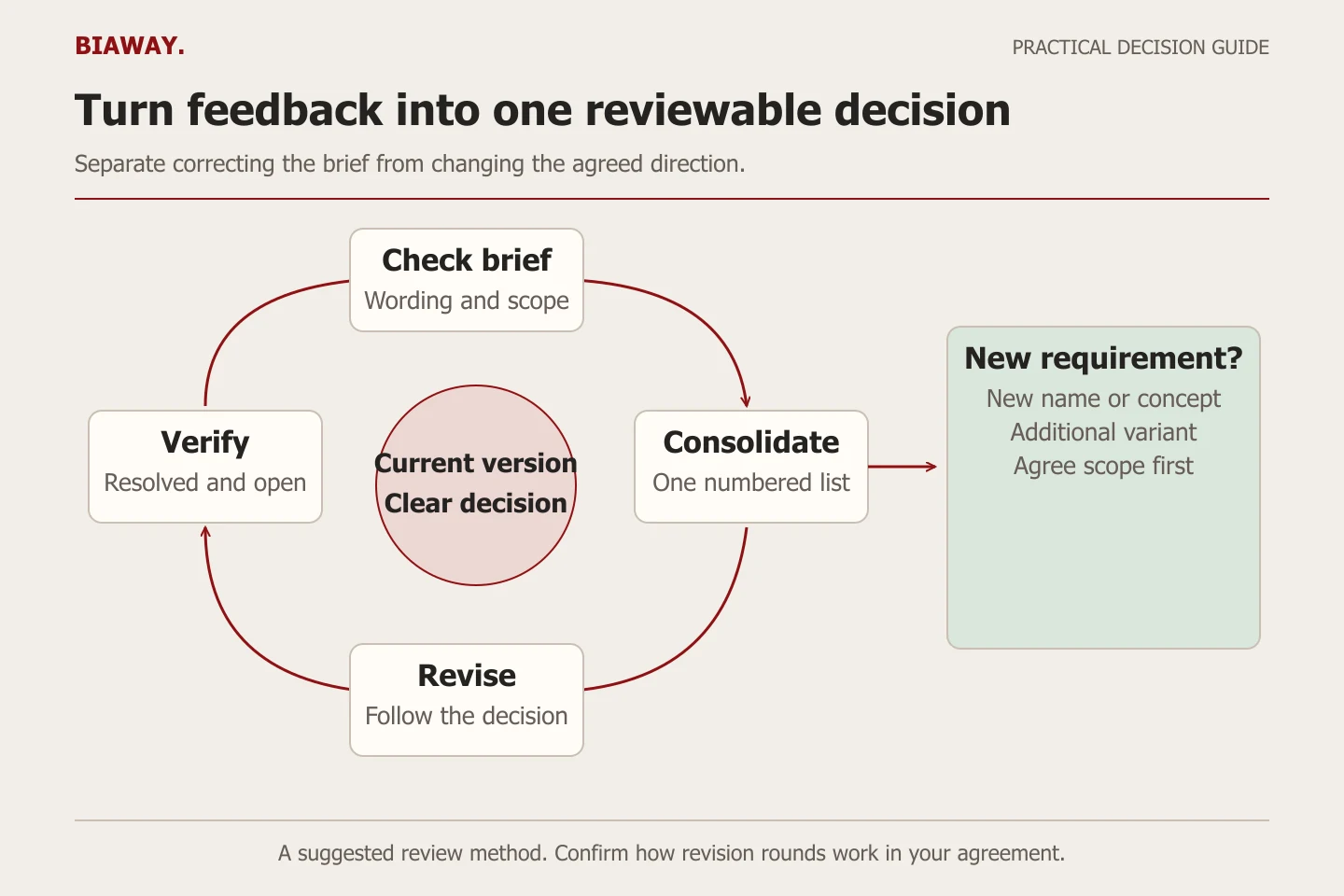
Keep one review record instead of scattered messages
Choose a review method your team can use: a shared document, annotated PDF or a supported review link. Adobe Illustrator's review workflow, for example, can collect comments and show updated artwork through a shared link. The important operating principle is one current version and a visible record of what was accepted or still needs attention; you do not need to buy a new tool just to follow that principle.
Avoid sending a voice note to one person, a screenshot to another and a revised name in a third chat without consolidating them. If a call resolves a decision, add the result to the written record. A numbered comment such as 'R1-04: increase the Arabic name's readability in the profile example' remains understandable when the project is reopened later.
Do not distribute confidential drafts more widely than necessary. Give reviewers access appropriate to their role and retain the final approved copy. A review link is a working method, not a reason to publish an unfinished identity publicly.
References: Adobe Illustrator: share documents for review and manage comments
Make one decision when reviewers are in different cities
An illustrative family business may have an owner in Hofuf, an administrator in Mubarraz within Al Ahsa and sales colleagues in Dammam and Khobar. A distributor in Riyadh and a partner in Jeddah may also need to check that the name remains clear on their documents. Collect those comments into one approved list rather than allowing six separate instructions to become six competing directions. This example describes a possible review arrangement across Saudi Arabia, not actual Biaway customers or offices.
Biaway delivers online. Agree a review deadline in Saudi time, state who can make the final decision and distinguish language accuracy from personal taste. Someone can correctly flag an Arabic spelling error without having authority to replace the entire visual direction. That distinction keeps remote approval clear while allowing the right people to catch real mistakes.
Close the project with an explicit acceptance record
A useful final approval names the version and the accepted variants, confirms the wording and identifies any remaining delivery tasks. 'Looks good' in a chat can be ambiguous when several images were sent. Prefer a record such as: 'We approve version 03, the Arabic primary mark and the compact profile version shown on pages 1 and 2; the agreed export files are still due.' This is an illustrative wording example to adapt to the actual agreement.
Then inspect the handover. A design can be approved while a file is still missing, an export is corrupted or a wrong version was included. Report that specific delivery issue instead of reopening every visual decision. Keep additional applications or new concepts in a separate request with their own scope, price and approval where applicable.
How this guide was prepared
Prepared with AI assistance, with platform and accessibility claims checked against the primary sources below at publication. The planning frameworks are Biaway’s editorial recommendations. Examples labelled illustrative are not client stories or measured results. Platform features and requirements can change.
Your questions.
01How many logo revisions should I expect?
There is no single number that applies to every project. Biaway's published starter-branding package lists up to two rounds. Confirm what a round means, the initial concept scope and how added work is handled in your proposal.
02Does each message count as a revision round?
Do not guess. Agree the definition before work starts and consolidate feedback into one numbered list. A provider's written process should explain when a round starts and closes.
03What if the delivered logo has a spelling mistake?
Compare it with the approved wording and report the exact mismatch. Distinguish correction of an agreed requirement from changing the business name after approval; confirm the applicable handling with the provider.
04Can I request a completely different logo during the last round?
You can raise the requirement, but it may be a change of direction rather than a refinement. Pause to agree its effect on deliverables, cost and timing before additional design begins.