Should your Saudi business use a PDF catalogue, product pages or both?

Use a product page for information buyers need to act on and keep current; use a PDF when a stable document has a clear download or sharing job. Many Saudi suppliers need both, but each format needs an owner and an update rule. Neither a PDF nor an HTML page earns visibility simply by existing.
In this guide
Choose the customer task before choosing the format
A catalogue is a way of organizing an offer, not necessarily a PDF. List what the buyer needs to do: discover a range, compare a specification, share an approved document, ask for a price or place an order. A downloadable document can be valuable for one task and inconvenient for another. Choose the format after identifying the task and the person who keeps its information accurate.
Start with a representative sample rather than converting every old page into a new format. Select one frequently changing product, one technical document and one configurable range. Ask a salesperson and an approver to explain how each is used. The answer may be three different treatments, which is more useful than requiring the whole business to use one format.
Keep search visibility separate from the format decision
Google lists both HTML and PDF among supported indexable formats. A PDF is therefore not inherently invisible to Search, and converting it to HTML does not guarantee indexing or higher rankings. Assess whether the chosen format presents useful, current information and whether people can reach it.
Google recommends linked navigation to product pages rather than relying on internal search for crawler discovery. Link important ranges and products from the appropriate category. Use a document library to support the buying journey, with clear download labels.
References: Google Search Central: File types indexable by Google · Google Search Central: Ecommerce website structure
Allocate the information using a small decision sheet
The following original worksheet describes an invented equipment supplier. It is a planning example, not a recommendation to create a page for every part number. Separate useful maintained information from material that merely repeats the same description. Name an approver for unknown specifications before publication.
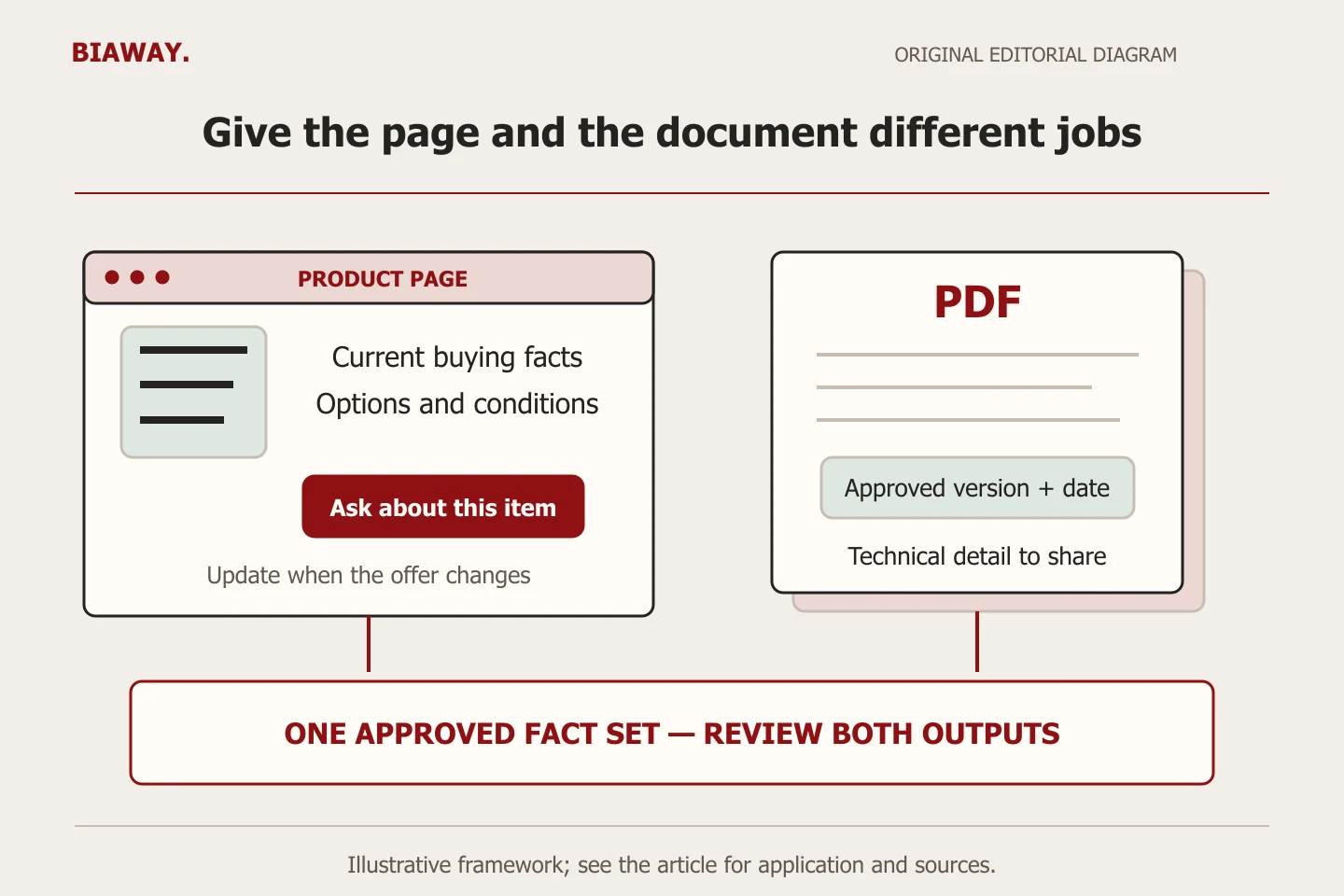
An HTML summary and a PDF do not need identical content. The page can answer the purchase decision and point to a dated technical document for detail. Keep shared facts consistent. When the specification changes, the owner should know which page, document and sales reference require review.
Scroll the table sideways to read every column.
| Item and buyer task | Public format | Update owner and trigger | Next action |
|---|---|---|---|
| Standard item with changing options | Maintained product or useful category page | Catalogue owner checks options when the offer changes | Ask about the selected item |
| Stable technical specification to circulate | Identified PDF linked from its relevant page | Technical approver issues a dated revision | Check suitability with the team |
| Made-to-order range needing a scope discussion | Range page with examples and clear limits | Sales owner reviews requirements and exclusions | Submit a qualified quotation request |
Make the current version identifiable after it is shared
A file forwarded through messages can outlive the page from which it was downloaded. Put a document title, relevant product reference, revision date or version and a route to the current information inside the document. Avoid including a price that changes frequently unless the business accepts the work needed to maintain and explain it. A date label does not correct inaccurate content; it makes the responsibility visible.
Keep a private register of the approved source, public file address, pages linking to it and the responsible person. Decide whether a revision replaces the file at its existing address or creates an archived version with a clear current link. If addresses change, review shared links deliberately. Do not casually remove specifications that existing buyers still need, and do not leave obsolete sales files looking current.
Test a real buying task in both formats
Give a reviewer a concrete task: identify the material, locate the required dimension and find the appropriate enquiry route. Ask them to complete it on a phone without instructions. Record the point where they cannot find a fact or misunderstand the offer. A beautiful cover does not resolve a missing unit, ambiguous product reference or a download that opens to an unrelated page.
W3C's PDF technique explains that tag and reading order matter for keyboard and assistive-technology use; visual order alone can be misleading. Review the exported document, including reading sequence and interactive links, instead of assuming the original design file proves accessibility. Treat this as part of document acceptance, not a claim that one check establishes complete compliance.
- Open the page and document from the actual public link on a narrow screen.
- Find the same sample product and confirm that its reference, units and approved facts agree.
- Check Arabic and English labels, and identify the language before an optional download.
- Follow the enquiry link and confirm that the relevant product context remains understandable.
- Record corrections, repeat affected tasks, and retain the approved file version.
References: W3C WAI: Correct tab and reading order in PDF documents
Use Saudi coverage to explain the enquiry, not duplicate the catalogue
Imagine a supplier in Saudi Arabia whose buyers in Hofuf and Mubarraz within Al Ahsa share a product specification with purchasing teams in Dammam and Khobar. The physical specification should not change with the buyer's city. The page can separately explain how the team confirms collection, transport or a site quotation under its actual operating arrangements.
For a buyer in Riyadh or Jeddah, an easily shared PDF may support internal approval, while the current product page explains what information is needed to assess delivery. Do not put unsupported nationwide availability into a document simply because it is easy to forward. Biaway coordinates website work online; this example does not imply its own warehouses, branches, delivery service or clients in these locations.
Price the upkeep as well as the first conversion
Before commissioning work, record the number of distinct product or category pages, documents, languages and genuinely different layouts. Distinguish supplied text from copy that needs writing, verified specifications from missing data, and ordinary downloads from searchable catalogues or custom ordering. A quotation should name these tasks rather than hide them inside 'upload the catalogue'.
Ask who will update both formats, where editable originals will be held and how a change is approved. Biaway can discuss the website architecture around your buyer tasks, while document production, complex catalogue conversion and specialist accessibility work require explicit scope. Start with the approved sample, accept its behaviour, then extend the pattern to the rest of the catalogue.
How this guide was prepared
Prepared with AI assistance, with platform and accessibility claims checked against the primary sources below at publication. The planning frameworks are Biaway’s editorial recommendations. Examples labelled illustrative are not client stories or measured results. Platform features and requirements can change.
Your questions.
01Can Google index a PDF catalogue?
PDF is a supported format, but support does not guarantee indexing or ranking. Keep the document useful and reachable, and assess its actual Search status separately.
02Should every item in a PDF get its own product page?
Only when a distinct maintained page helps a buyer. A well-explained range or category may be more useful than many nearly identical pages.
03Should we copy all PDF text onto the website?
Choose the information each format needs. A page can explain the current offer while a linked document supplies an approved technical detail; keep shared facts consistent.
04Is a flipbook the same as an online store?
No. A viewer can present a catalogue, but product selection, pricing, checkout and order handling are separate requirements that must be scoped and tested.