Can a Saudi business use trending music in TikTok videos?

A trending sound is not an approval record. Decide the intended business use, check the exact soundtrack and retain the evidence before the video reaches your publishing calendar.
In this guide
Choose the permitted use before choosing the song
A Saudi business should not select a TikTok soundtrack solely because it is trending or appears in another company’s video. First establish where the finished clip will appear, whether it will promote a business, and who can confirm the permission for that use. Then choose a sound that fits the approved scope. Popularity, a visible sound button and an editor’s downloaded file are not substitutes for that decision.
TikTok’s business guidance directs commercial TikTok activities, including organic posts, ads and branded content, to its Commercial Music Library, or CML. It says other users’ original sounds and other licensed sounds require appropriate permission. This is TikTok-specific guidance checked on 17 October 2026; it does not establish clearance for Instagram, YouTube or a business website.
References: TikTok for Business: Commercial Music Library
Describe the publishing job in one sentence
Before editing, write a brief such as: “Create a short product demonstration for this business’s TikTok account, with Arabic captions; a paid version is a separate approval.” This gives the editor a real destination and purpose. “Use it on all our channels forever” leaves too many decisions unresolved. List every intended destination, account, use and relevant campaign region separately, even when the visual footage will be shared.
Decide who owns the audio decision. The business can approve its intended use and supply its records; the editor can identify the selected sound and flag missing evidence. If a licence needs interpretation, obtain an appropriately qualified review instead of asking the scheduling assistant to guess. The approval record should distinguish verified permission, a question awaiting an answer, and an option deliberately rejected.
Check the exact library selection in the current account
TikTok’s documented CML workflow includes selecting the campaign region and filtering by usable placements. Its instructions describe Commercial Sounds access in the app. Check the actual track and current account workflow rather than assuming a similarly named recording or an old saved favourite has the same availability.
For your working record, capture the track identity, the library page or in-app reference, the date checked and the intended TikTok use. These records make the team’s reasoning inspectable; a screenshot by itself does not expand a licence. If the account does not show the expected option, stop that soundtrack choice and resolve the discrepancy before the edit is scheduled. Do not work around the question by exporting a copy from someone else’s post.
References: TikTok for Business: how to use the Commercial Music Library
Keep a permission register beside the content calendar
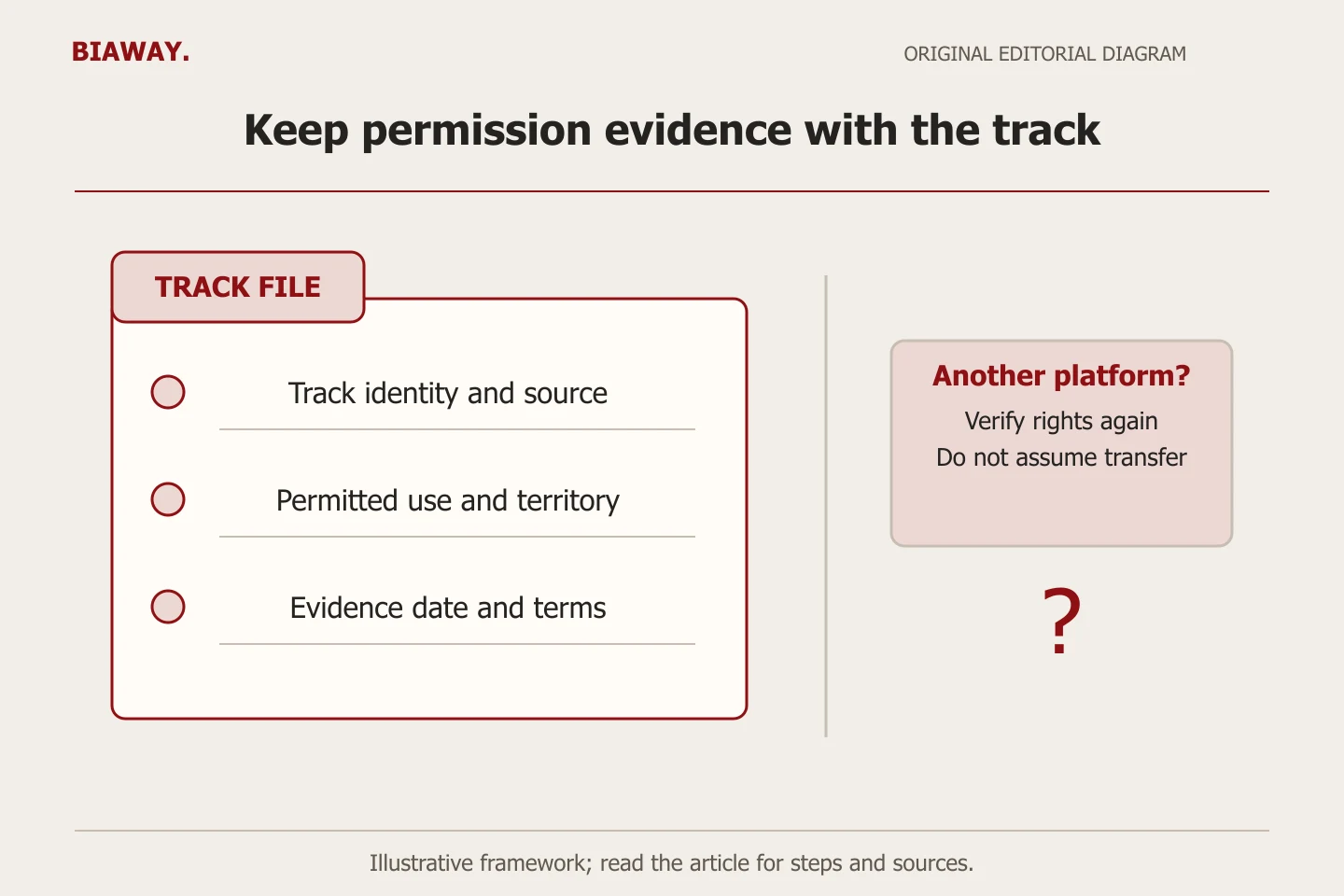
The following is an original production checklist, not a licence document. Complete one row for each soundtrack and destination. Use plain answers such as “verified for this TikTok use” or “waiting for clarification”, not a blanket green tick attached to the whole campaign. A person returning to the project next month should be able to see exactly what was approved.
Keep permission records in the private project folder. The public post does not need internal approval notes, personal staff details or a copy of a commercial agreement. Give the scheduler only the approved export, its destination and any practical publishing conditions.
Scroll the table sideways to read every column.
| Field | What to record | Hold publication when |
|---|---|---|
| Clip and track identity | Version name, soundtrack title and exact source reference | The editor cannot identify which recording is embedded |
| Destination and account | TikTok account and any separate proposed platform use | Another platform has been added without its own review |
| Purpose and region | Organic or paid use and the actual intended market | The intended campaign differs from the checked scope |
| Permission evidence | Current library record or reviewed separate permission | Only a trend link or “royalty-free” label is available |
| Approval and date | Named approver, review date and unresolved conditions | The owner or scope is still undecided |
| Export control | Approved audio version plus a clean video master | The scheduler has several indistinguishable files |
Work through one video with three possible destinations
Illustrative example: a fictional interiors workshop has a video showing a sample display, with no client or completed-project claim. The team chooses a CML soundtrack after checking the intended TikTok use. The calendar then expands to an Instagram post and a website hero. These are three publishing decisions, not one video file with three automatic permissions.
Keep the TikTok decision tied to its recorded evidence. For the other destinations, review a separately suitable soundtrack or publish an approved voice-led version with no added music while the audio question is resolved. Retain a clean visual master so replacing sound does not require remaking the footage. This example does not conclude that a particular track is permitted or prohibited elsewhere; the team has not supplied that evidence.
A second mistake is changing an approved organic clip into a paid placement without revisiting the recorded scope. Build that check into the handover. Similarly, a music file supplied by a freelancer should arrive with an identifiable source and permission information, rather than a filename that merely says “commercial”.
Separate Saudi customer coverage from soundtrack permission
For a hypothetical workshop in Al Ahsa, footage of a display prepared in Hofuf or Mubarraz may support a genuine local collection message. A version sent to potential buyers in Dammam and Khobar might instead discuss consultation or delivery, if those services actually exist. Confirm these business facts in the script; do not turn a soundtrack choice into an unsupported claim about project coverage.
If the campaign also targets Riyadh and Jeddah, record the actual Saudi Arabia campaign scope and the intended account or placement during audio review. City names in a caption do not answer the permission question, and another merchant’s successful upload is not proof for your use. Biaway can coordinate content preparation remotely across these areas; this does not imply branches, local filming teams or existing workshop clients.
Make changes and responsibility part of the proposal
Ask the content provider to identify who selects sounds, who checks the permission record, who approves the final export and who retains the editable project. Specify whether the work includes preparing separate platform versions or replacing audio after the business changes its plan. These are useful scope questions for social media management; they should not become an unstated promise of legal clearance or unlimited revisions.
Before release, watch the approved export and confirm that it contains the recorded soundtrack, not a temporary editing track. Check speech clarity, caption timing and whether any audible background material needs its own review. After release, preserve actual platform notices and the affected file version. Resolve a disputed or unclear use before reposting it; do not assume changing volume, shortening a track or switching accounts answers the underlying permission question.
How this guide was prepared
Prepared with AI assistance, with platform and accessibility claims checked against the primary sources below at publication. The planning frameworks are Biaway’s editorial recommendations. Examples labelled illustrative are not client stories or measured results. Platform features and requirements can change.
Your questions.
01Can my business use a trending TikTok sound because competitors do?
A competitor’s post does not establish permission for your recording, account or use. Check the exact sound and documented scope before including it in an approved business export.
02Does an unpaid business video avoid the music question?
No. TikTok’s business guidance includes commercial organic content. Describe the actual purpose of the post, rather than treating the absence of advertising spend as permission.
03Can I download a finished TikTok and repost it everywhere?
Do not assume the soundtrack is cleared for additional destinations. Review each proposed platform use and keep a clean video master so a different approved audio version can be prepared.
04What should a social media provider hand over?
Request the agreed final versions, exact soundtrack references, approval record and any editable or clean-master files included in scope. Clarify who resolves permission questions and how later changes will be handled.