How should you choose a payment gateway for a Saudi store?

Choose a payment gateway by its fit with your platform, business account and purchase journey. This guide turns a vague search for the best provider into a documented comparison of compatibility, fees, responsibilities and test results.
In this guide
Choose a working payment route, not the longest logo list
Start with the platform you will use, the business that will receive the money and the payment methods your customers actually need. Then compare the provider's current integration, approval requirements, complete fees, settlement arrangements and support. There is no single best payment gateway for every Saudi store, and a low advertised transaction rate cannot establish whether the service fits your checkout.
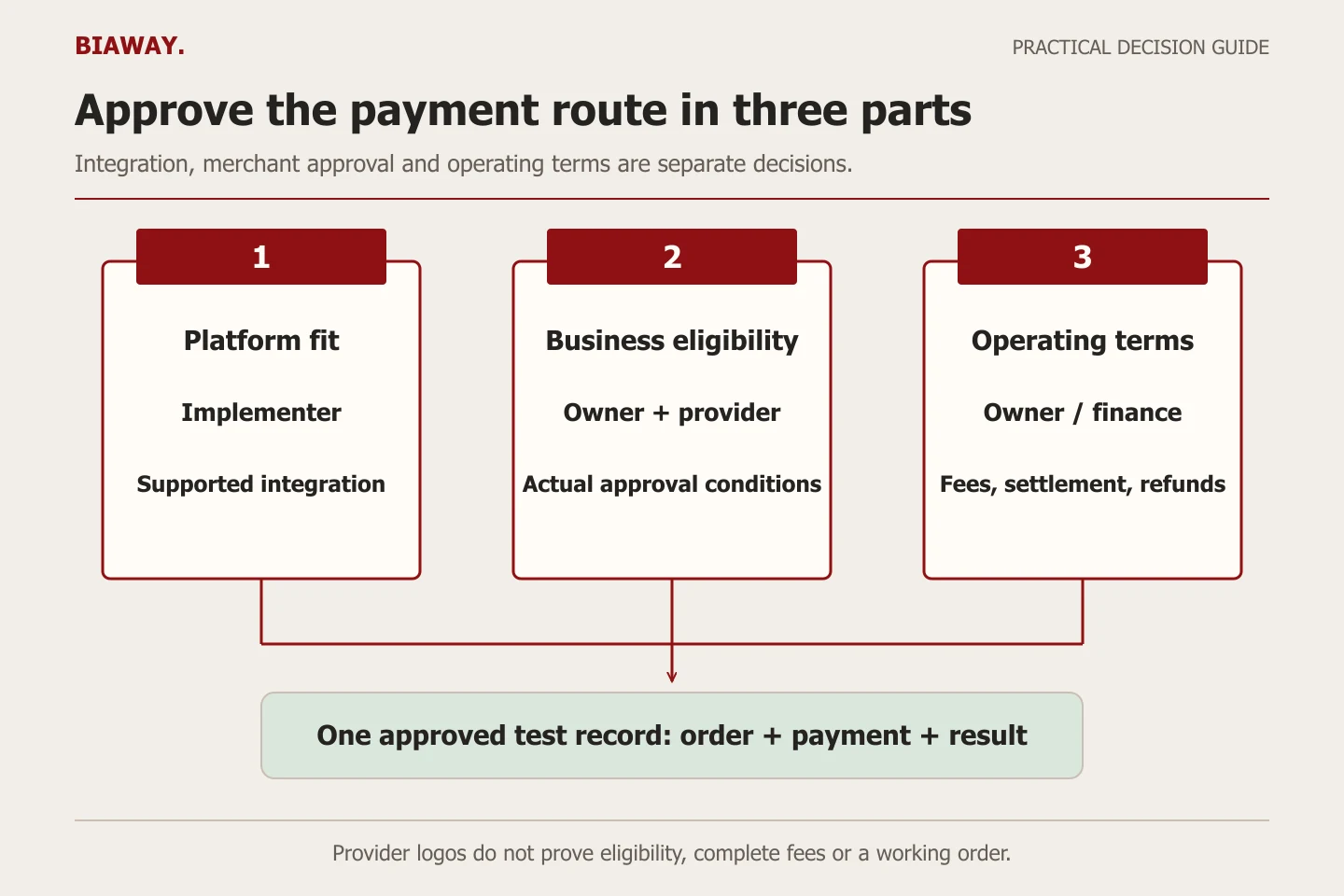
A useful decision ends with evidence: the provider confirms eligibility, the implementer confirms the supported integration, the owner understands the commercial terms, and the agreed test journey works. Treat any unknown as a question to resolve before committing to a launch date. This guide is a selection worksheet, not a ranking of providers or a promise of approval.
Separate platform compatibility from merchant approval
A provider may support a payment method without offering the same integration on every commerce platform. Ask for the exact current plugin, supported platform version or documented connection that the implementer will use. Shopify, for example, distinguishes payments completed within the store from external-provider checkout journeys. Review that behavior on a phone in both required languages.
Approval is another workstream. The merchant should obtain the provider's current requirements for its own business type and account. A designer can implement an agreed connection; that does not mean the designer can guarantee approval, settlement eligibility or acceptance of every product category. Keep account ownership and provider correspondence under the business's control.
References: Shopify: third-party payment providers
Use a comparison sheet with evidence beside each answer
Shortlist providers only after essential compatibility is confirmed. Ask each the same questions and save the answer date. A blank cell is an unresolved requirement, not a zero cost or an assumed feature. The following worksheet is an original planning framework; it is not a certification checklist or a provider score.
Scroll the table sideways to read every column.
| Decision | Evidence to request | Who checks it |
|---|---|---|
| Platform and checkout | Current integration and supported payment journey | Implementer |
| Business eligibility | Provider's requirements for your actual business | Owner and provider |
| Payment methods | Methods available to this merchant and integration | Provider |
| Complete charges | Dated commercial terms including applicable extras | Owner |
| Settlement and refunds | Timing, conditions, handling and reporting | Finance or owner |
| Testing and support | Test instructions, escalation route and responsibility | Implementer and owner |
Compare the complete cost, including the platform
Separate provider transaction charges, platform charges, implementation work and any optional services. Ask whether a quoted percentage has a fixed amount per transaction, a recurring fee or conditions that change the charge. Also ask how the provider handles refunds, disputes, currency conversion or settlement-related charges where relevant. Do not assume an advertised 'free' account means free live payment processing.
Illustrative arithmetic only: if a hypothetical contract charges 2% plus SAR 1 per payment, a SAR 200 payment costs SAR 5 under that formula. One hundred such payments would cost SAR 500 before any other applicable charges. These are invented numbers for understanding the calculation, not a quote from a provider or a Saudi market average. Replace them with the actual dated terms.
Shopify states that third-party transaction fees can apply to third-party and alternate gateways. Check the specific plan and arrangement instead of counting only the gateway's price. Do not generalize Shopify's charging model to another platform.
References: Shopify: third-party payment providers
Check the methods and the whole test journey
Moyasar's current documentation is one example of a provider documenting web payment methods and a sandbox for integration testing. A list of supported methods is useful research evidence, but it is not confirmation that every method is activated for your account, device and platform configuration. Ask the provider to confirm the exact combination you intend to launch.
Agree a test plan using the provider's supported test environment. Cover success, a failed or cancelled attempt, return to the store, the order record, the amount and currency, and the customer's message. An attractive payment button or a success-looking browser screen is not enough. The business must know which order is paid and which still needs attention.
- Record the platform, test environment and payment methods covered.
- Run approved scenarios without exposing real customer or card information in reports.
- Check the order and payment records against the customer-facing result.
- Document unresolved errors and the party responsible for each.
- Repeat the agreed checks after the final production configuration is approved.
References: Moyasar: developer documentation and test environment
Keep payment selection separate from delivery coverage
Consider an illustrative Saudi Arabia retailer offering collection in Hofuf and Mubarraz within Al Ahsa, delivery to Dammam and Khobar, and parcel shipping to Riyadh and Jeddah. A supported card method does not prove that every basket can be fulfilled to all those destinations. The checkout must apply the merchant's real product and delivery rules before it asks the customer to pay.
Use a small set of approved destination scenarios when reviewing the integration. Include an unsupported destination or a product that cannot use the selected delivery method, and confirm the customer receives a clear explanation rather than an unexpected payment attempt. Biaway can coordinate the website work remotely; delivery promises and payment-account approval remain with the responsible business and providers.
Specify ownership, support and Biaway's setup boundary
Write down who controls the merchant account, who can change the connection, where settlement reports are found and who contacts the provider if payments stop working. Use individual access where supported and avoid circulating secret credentials in project chats. Keep a redacted handover record with configuration responsibilities, test results and the provider support route.
Biaway's catalogue checked on 16 October 2026 lists ecommerce setup at SAR 700 one-time, including up to 25 products and standard payment-gateway integration within the published scope. That setup price does not establish provider charges, approval terms, custom payment development or ongoing specialist payment operations. Confirm the platform, required methods, languages and exclusions in the written proposal.
References: Biaway: website and ecommerce service scope
How this guide was prepared
Prepared with AI assistance, with platform and accessibility claims checked against the primary sources below at publication. The planning frameworks are Biaway’s editorial recommendations. Examples labelled illustrative are not client stories or measured results. Platform features and requirements can change.
Your questions.
01Which payment gateway is best for a Saudi online store?
The right choice depends on the exact platform, business eligibility, payment methods, complete charges and operating requirements. Compare confirmed answers for your merchant account rather than selecting a provider from a generic ranking.
02Can I use a payment gateway for free?
A free account or test environment does not establish free live processing. Ask for the full current commercial terms and include any platform charges before comparing costs.
03Does a website designer obtain merchant approval?
Implementation and approval are separate. Confirm what assistance is included, but the merchant and payment provider must complete the provider's actual eligibility and account process.
04Should I add every available payment method?
Prioritize the methods needed for the launch and supported by the actual integration. Each added route needs appropriate configuration, testing and an owner who understands its order and payment records.