Should your Saudi store require a customer account?

A customer account should solve a real need before it becomes a condition of purchase. Compare public retail, returning customers and restricted access, then test the selected policy on the actual platform in Arabic and English.
In this guide
Make account creation earn its place in checkout
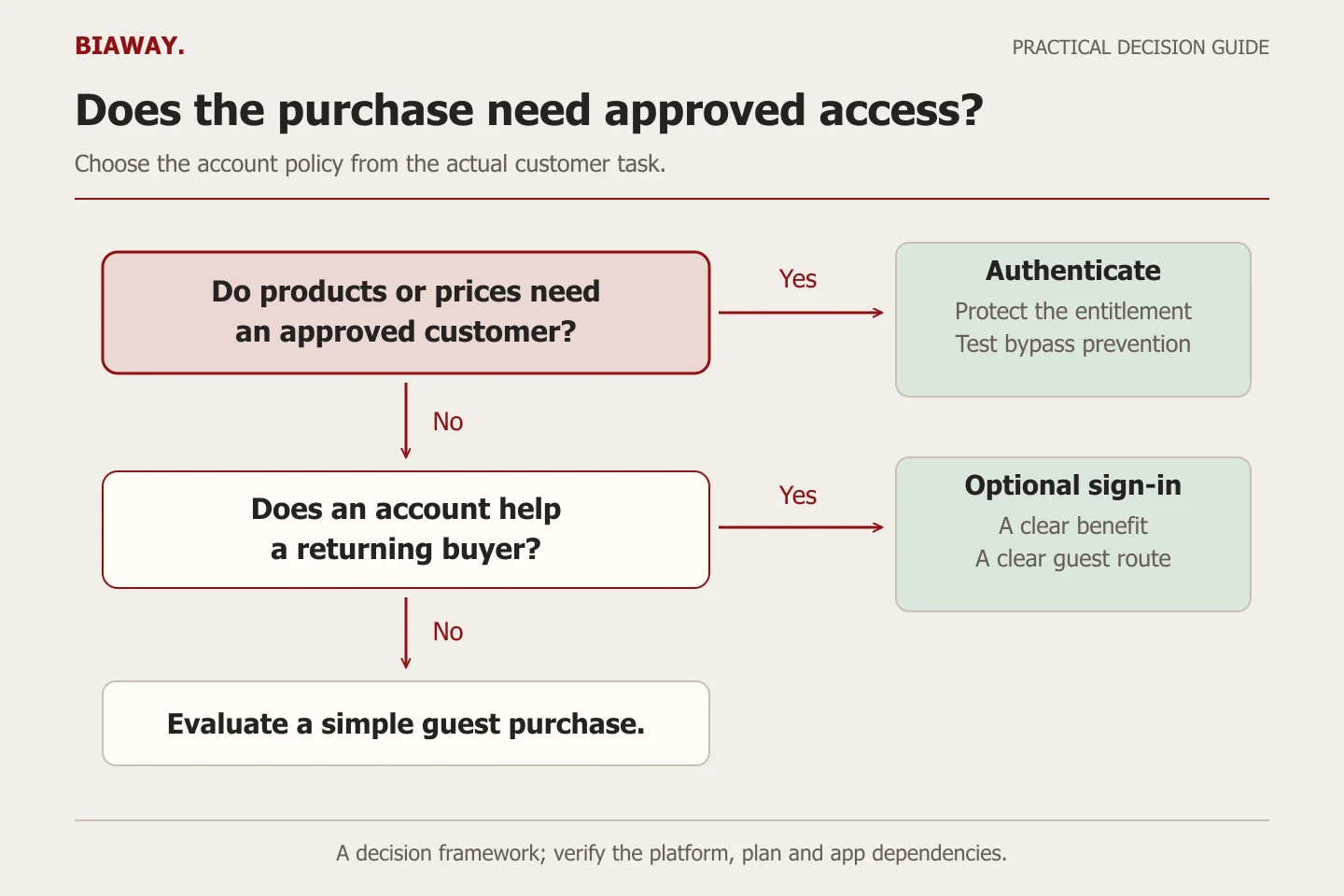
For a public retail store, consider allowing a first purchase without mandatory sign-in when your platform and operating rules permit it. Keep an account available for customers who benefit from saved details or repeat purchases. Require authentication when the sale genuinely depends on knowing an approved customer, such as access to agreed business pricing. The decision should follow a documented need, not the idea that a longer customer database automatically means a stronger business.
Guest checkout means the buyer is not required to sign in before placing that order. It does not mean anonymous payment, no delivery information, no order record or exemption from the store's terms. An optional account and a mandatory account are different experiences. Ask your implementer to show each journey on a clean browser, because an already signed-in owner's session can hide the obstacle a new customer encounters.
Use this decision tree before changing the setting
Write the business reason in one sentence: 'The customer must be identified before purchase because…'. If the answer is only that the marketing team wants more registrations, compare that request with the extra step imposed on every buyer. An account should provide a defined service or access rule. It should not become an unexplained gate between a product and its advertised purchase path.
- Identify whether authentication protects a real entitlement or merely collects an extra registration.
- List the useful account features your store will actually maintain.
- Confirm the chosen platform's available settings and the effect on payment shortcuts.
- Approve the guest, returning-customer and restricted-access test cases before launch.
Scroll the table sideways to read every column.
| Customer situation | Policy to evaluate | What must be demonstrated |
|---|---|---|
| Anyone can buy the same public products | Guest purchase with optional account | A new visitor can finish the permitted order without a sign-in detour |
| Returning buyers want saved details and order access | Visible optional sign-in | Signing in helps them, while the guest route remains understandable |
| Prices or products depend on approved eligibility | Required authentication where supported | An unapproved visitor cannot bypass the access rule |
| A feature depends on a particular account integration | Check that dependency before choosing | The platform, plan and relevant app support the actual promised journey |
Check current platform behaviour, not an old tutorial
Shopify's current customer accounts support order access and saved profile information, with email-code sign-in rather than a required password. Showing account sign-in links does not itself answer whether checkout must require authentication. These are related choices to inspect in the actual store configuration.
Shopify's checkout settings can require sign-in. Its documentation says that this setting limits checkout contact to email and removes accelerated checkout options such as Apple Pay from the online store cart. That is a specific Shopify consequence, not a rule for every platform. Review the documented behaviour before changing a live store, and confirm any app or plan dependency with the implementer.
References: Shopify: current customer accounts and sign-in · Shopify: checkout form and sign-in requirements
Separate a first retail order from a repeat business purchase
Consider an illustrative Saudi home-accessories store selling public products and also supplying a small group of approved trade customers. A first-time retail buyer wants one lamp. A trade buyer needs the prices and permissions agreed with the business. These are hypothetical operating cases, not Biaway customer results. For the retail route, evaluate guest purchase plus a clearly labelled optional account. For the trade route, confirm an authenticated arrangement that actually protects the agreed terms.
Do not ask the retail buyer to solve the trade workflow merely because both groups use one brand. Conversely, do not expose restricted terms through an unrestricted checkout shortcut. The practical brief should identify which journey belongs to which audience, what happens to a mixed basket if that is possible, and who resolves an access problem. A visual label saying 'trade customer' is not an access-control test.
If you change the policy, record the date and compare similar periods and customer groups. Review completed paid orders, unsuccessful sign-in attempts and support complaints together. A rise in account registrations alone does not establish better sales, and a small before-and-after sample cannot isolate the setting from promotions, stock changes or traffic quality.
Test the journeys that a signed-in owner will miss
Use an authorised test environment or supported payment test mode, with synthetic details and a documented cleanup process. Avoid real charges, production customer records and unnecessary marketing messages. Record the device, language, account state and result for each case so a developer can reproduce a failure.
- Open a fresh session, add a permitted product and check whether guest purchase is clearly available when that is the approved policy.
- Sign in as an authorised test customer, then check that the basket and selected options survive the transition.
- Test a mistyped email, a missing or expired sign-in code and the route back to the basket without losing useful input.
- Repeat in Arabic and English on mobile, including the payment shortcuts the implementation actually supports.
- For a restricted route, try the normal guest entry and verify that it cannot expose protected prices or complete an unauthorised order.
- Confirm the final order and customer notification once in the permitted test workflow; a successful account sign-in is not proof of a successful order.
Keep the account rule separate from delivery coverage
An illustrative store may permit delivery in Hofuf and Mubarraz within Al Ahsa, use another arrangement for Dammam and Khobar, and offer a different service to Riyadh or Jeddah. Test only the areas the real operation serves. A guest checkout should still apply the correct destination rules; a customer account should not silently grant delivery to an excluded area. This is an acceptance framework for Saudi Arabia, not a claim that every city has the same price, availability or delivery time.
Biaway works online. The owner supplies the approved coverage and customer-access rules, while the implementation brief identifies who configures and checks them. Customer location alone is not a reason to force account creation. Where the real business requires a verified customer relationship, explain that requirement before the buyer reaches the final step.
Specify the policy and the handover responsibility
Your brief should name the chosen account policy, allowed sign-in methods, actual account features, supported languages, restricted customer groups and the person responsible for access issues. Add the agreed acceptance cases and the support route if a platform update changes the experience. Keep sign-in access and marketing preferences as separate decisions in the specification.
Biaway's published e-commerce package includes catalogue, cart and checkout work within its stated scope, with standard integrations and up to 25 products. A specialist membership system, trade-price portal, custom authentication or a paid app is not automatically included. Share the actual requirement before the proposal is agreed. The useful deliverable is a working, tested purchase journey with clear ownership, not simply a checkbox labelled 'customer accounts'.
References: Biaway: website and e-commerce package scope
How this guide was prepared
Prepared with AI assistance, with platform and accessibility claims checked against the primary sources below at publication. The planning frameworks are Biaway’s editorial recommendations. Examples labelled illustrative are not client stories or measured results. Platform features and requirements can change.
Your questions.
01Does guest checkout mean I cannot keep an order record?
No. A guest order can still need contact, payment and fulfilment details. Guest checkout concerns whether sign-in is required before purchase; it does not remove the business's order-handling responsibilities.
02Will guest checkout definitely increase my Saudi store's sales?
No guaranteed improvement follows from one setting. Test whether the current sign-in requirement obstructs your actual buyers, then compare completed orders and support issues while accounting for traffic, offers, stock and sample size.
03Should a wholesale customer use the same guest route as a public retail buyer?
Only if that route respects the business's actual pricing and eligibility rules. When access must be restricted, verify the supported authentication arrangement and test that shortcuts cannot bypass it.
04Can I add optional accounts after launching the store?
Often that is an implementation option, but check the platform, existing customer data and connected apps first. Agree migration and testing responsibilities before changing a live purchase journey.