What should a freight quote form ask before a logistics team prepares an estimate?

A useful freight quote form gives the logistics team enough information to route an enquiry and decide what to clarify next. Start with the origin, destination, service or transport mode, a cargo description and the date or frequency. Let a prospective shipper mark estimates as provisional and request help when they do not know a measurement. The form should qualify the conversation without pretending that a submitted form is a confirmed booking or price.
In this guide
Start with the freight decision, not a long form
Design the first screen around the decision the receiving team must make: what service might fit this movement, where the shipment starts and ends, and which cargo facts are already known. A route-only message can be useful for an early conversation; a detailed cargo specification can be requested when the shipment needs it. Do not make every visitor complete a long technical questionnaire just to ask whether the provider handles a lane.
Published freight quote journeys commonly distinguish service or transport mode, origin and destination, cargo volume or weight and timing. That is an observation about the visible forms at Sent and GES Logistics, not evidence of their conversion rates or a universal industry requirement. Use your own operations team to decide which fields are required for each service.
References: Sent: Freight quote request form · GES Logistics Saudi Arabia: Quote enquiry
Collect the route and mode in clear, comparable fields
Ask for origin and destination as separate city, country, port or facility fields that fit the service offered. State whether the form is for domestic movement, international freight, transport, warehousing or another verified service. If a visitor cannot choose a mode confidently, offer “not sure—please advise” only when the team can actually review that request.
Use units beside every measurement. “Weight” could mean one package or the whole shipment; “volume” is not obvious to every visitor. Ask how many packages, pallets or containers are involved, then label gross weight and dimensions or volume with units. Allow the person to say that the values are estimates.
- Origin: city or port, with a more exact pickup location only when the service needs it.
- Destination: city or port, and whether final delivery is being requested.
- Service and mode: the operator’s real choices; do not list modes it does not handle.
- Cargo summary: goods description and package count, followed by the measurements needed to assess the chosen service.
- Timing: cargo readiness date, required delivery window if known, and frequency for recurring movements.
References: Sent: Freight quote checklist · GEODIS Saudi Arabia: Contact and quote guidance
Separate first-pass fields from optional follow-up
A staged form can keep the first step manageable: route and service first, cargo details next, then timing and contact. Add conditional questions only when an answer changes the next useful question. For instance, asking about a container type makes sense only after the visitor selects a service where container movements are handled.
Keep documents optional unless a confirmed operational process requires them. An upload field creates security, storage and access responsibilities. If the company has no approved secure workflow, collect a short description first and arrange the next step through its established channel. Never use a form to request passwords or unnecessary identity documents.
Scroll the table sideways to read every column.
| Field group | First-pass choice | Follow-up or optional detail |
|---|---|---|
| Route and service | Origin, destination, service type | Pickup constraints or delivery access details if relevant |
| Cargo | Goods description and package count | Weight, dimensions, volume, packaging or container detail; mark estimates |
| Schedule | Ready date or approximate timeframe | Required arrival window and repeat frequency when known |
| Special conditions | Ask only what changes routing or handling | Let the team clarify uncertain requirements; avoid implying compliance approval |
| Contact | Name and one reliable reply channel | Company or additional contact details only if the workflow needs them |
A worked example: make uncertainty visible
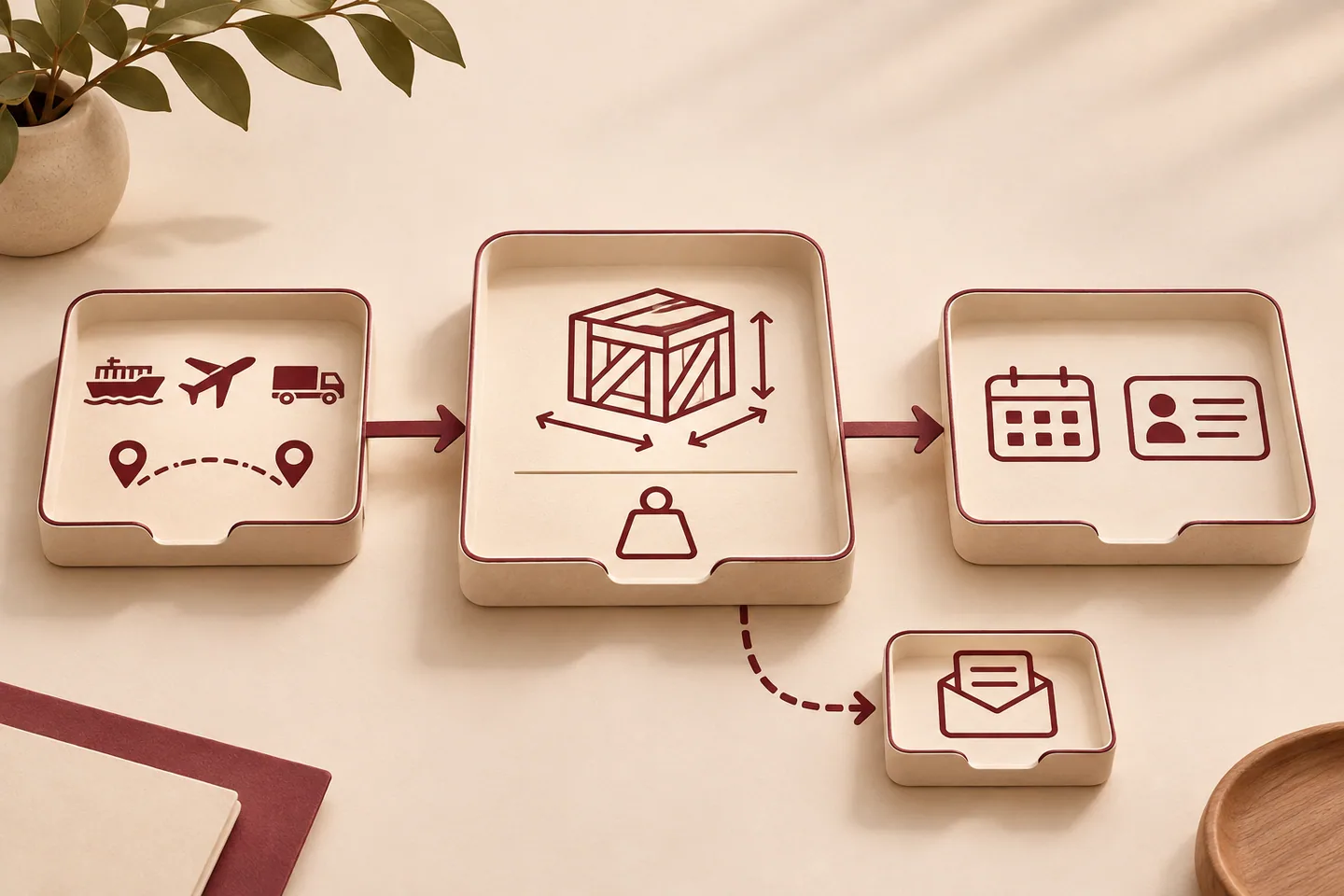
Hypothetical example, not a freight rate: a company has four pallets of packaged equipment to move from a storage site near Hofuf in Al Ahsa to a customer site in Riyadh. Each pallet is estimated at 180 kg, so the initial arithmetic is 4 × 180 kg = about 720 kg gross before packaging or measurement checks. The sender marks the weight as estimated, supplies approximate dimensions and a ready week, and asks the team to confirm which service options are available.
The numbers help the operations team ask a more useful next question; they do not determine chargeable weight, transit time, carrier availability or price. The form should show an honest confirmation such as “Your enquiry was sent; the team will review the details” rather than “Your shipment is booked.”
Represent routes and languages honestly across Saudi Arabia
A logistics operator should publish only the routes and services its operations team has confirmed. For example, origin options around Hofuf and Mubarraz within Al Ahsa may require different pickup instructions from movements handled through Dammam or Khobar. Riyadh and Jeddah can appear as destination examples only when the operator confirms those services. A form that accepts every city does not prove nationwide coverage across Saudi Arabia.
Keep the Arabic and English labels aligned for origin, destination, service mode, package count, units, estimates and confirmation messages. Ask a reviewer who knows the service vocabulary to approve the language pair. Biaway works online with businesses in Hofuf, Al Ahsa, Mubarraz, Dammam, Khobar, Riyadh, Jeddah and across Saudi Arabia; it does not claim a branch or offer freight services in those locations.
Test the form through to the person who owns the next step
Give each field a visible, purpose-specific label and instructions close to the control. W3C’s form guidance recommends associating labels with controls and providing understandable feedback. Test keyboard focus, mobile layout, Arabic right-to-left text, required-field errors and the success message. A placeholder should not be the only label.
Agree who receives each service type, what happens when a visitor chooses “not sure”, and how the team follows up without promising an unapproved response time. Submit clearly marked test enquiries before launch and confirm they reach the intended inbox or CRM. Test records are not real leads and should not enter business performance totals.
- List the service types the operator actually accepts and the team responsible for each.
- Separate route, mode and cargo fields from details that can be optional or confirmed later.
- Approve English and Arabic labels, units, error text, privacy notice and confirmation.
- Test one complete, one incomplete and one uncertain enquiry on desktop and mobile.
- Confirm the message is delivered and that the next owner can see the submitted context.
References: W3C WAI: Labeling Controls in Forms · W3C WAI: User Notifications
How this guide was prepared
Prepared with AI assistance, with platform and accessibility claims checked against the primary sources below at publication. The planning frameworks are Biaway’s editorial recommendations. Examples labelled illustrative are not client stories or measured results. Platform features and requirements can change.
Your questions.
01What information is usually useful in an initial freight enquiry?
Start with origin, destination, service or mode, a short cargo description, package count and a readiness date or timeframe. Add weight, dimensions, volume, frequency or special handling where the operator needs them. Mark estimates instead of presenting them as confirmed values.
02Should every shipment detail be mandatory?
No. Require only information needed to route and understand the first enquiry. Allow an honest “not known yet” option where a person can follow up. A mandatory field is appropriate only when the operator’s process needs it before accepting that request.
03Should the form ask visitors to upload shipping documents?
Only if the operator has an approved secure upload and retention process and the document is needed at that stage. Otherwise, collect the minimum enquiry details and arrange a safe follow-up.
04Can a logistics form list every Saudi city as a service area?
Only if the operator has verified that it can handle the stated service for those origins or destinations. A city list or successful submission does not confirm lane coverage, availability or delivery.