How should you choose Arabic and English fonts for a Saudi website?
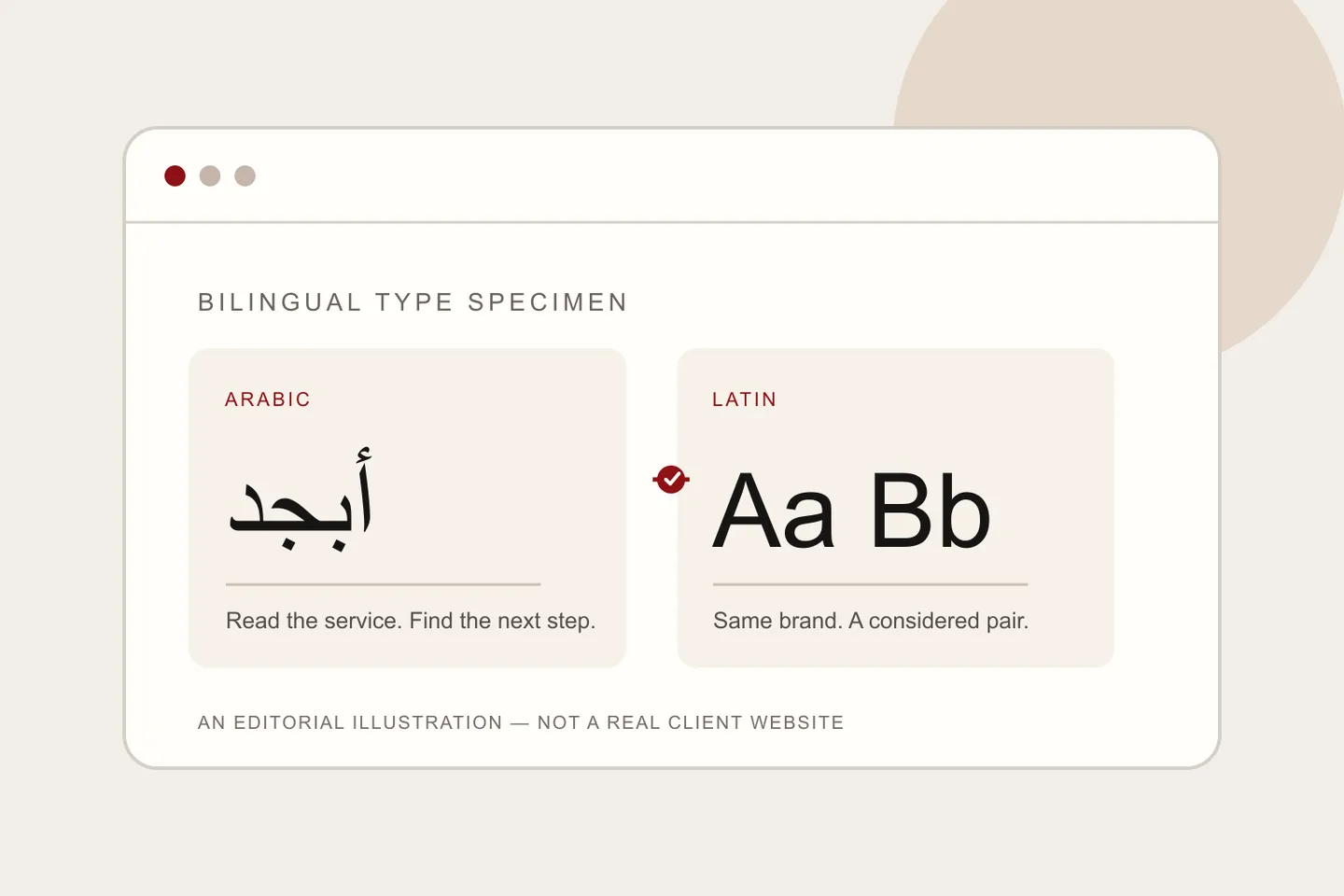
There is no single best Arabic font for every website. Compare real Arabic and English service text, forms, numbers and buttons in the same phone-sized layout. This guide gives Saudi business owners a repeatable way to approve a type pairing and the font files behind it.
In this guide
There is no single best Arabic font pair for every Saudi website
Choose typography by testing the words, screens and tasks your customers actually use. An Arabic and Latin pair is ready when both scripts feel like one brand, remain comfortable in long text, keep forms and numbers clear on phones, and load with a sensible fallback. A font name or a polished specimen alone cannot prove that it works in your site.
Start with the site’s purpose: a service company needs readable paragraphs, clear labels and reliable calls to action; a catalogue needs compact, distinguishable product details; an editorial brand may want a more expressive heading face while keeping body text restrained. You may use one family for both scripts or two related families. Neither approach is automatically better.
Compare fonts with a real bilingual page specimen
Before browsing font lists, collect a short set of real content: your Arabic and English service name, a paragraph, a navigation label, a price, a phone number, a form error and a button. Include a mixed line such as “احجز الآن — Book now” and the numbers or punctuation customers will see. Do not use customer personal information in a design specimen.
Place this same content in three candidate pairs using the same page width, type scale and component sizes. Compare the Arabic and Latin visually by apparent size and weight, not just by matching CSS numbers. Check Arabic joins and dots, punctuation, numerals, line breaks, button fit and paragraph rhythm. One attractive heading is not enough evidence to approve a full typography system.
- Long Arabic and English body copy at the smallest intended phone width.
- Service headings, navigation, forms, validation messages and calls to action.
- Dates, SAR prices, telephone numbers, Latin brand names and mixed-script phrases.
- Regular and bold weights actually needed by the design, including the fallback state.
Choose a pair for the brand and the work the page must do
A family that includes both Arabic and Latin can simplify the visual system. Two families can also work when their character, proportions and available weights complement each other. Compare stroke contrast, rounded or geometric forms, x-height and Arabic letter proportions; then judge the pair inside your own layout. The UAE Government Design System is one useful regional example of assigning separate English and Arabic type roles rather than expecting one typeface to solve every hierarchy. It is a reference, not a prescription for a Saudi business.
Keep long-form body copy comfortable before adding distinctive display typography. For a clinic or professional service, test treatment names, practitioner labels and appointment actions. For furniture or specialist automotive businesses, test model names, dimensions, finishes and technical specifications. A dramatic headline face may be suitable for a short heading yet tiring or ambiguous in dense specifications.
References: W3C: Declaring language in HTML
Use a simple approval scorecard, not a universal ranking
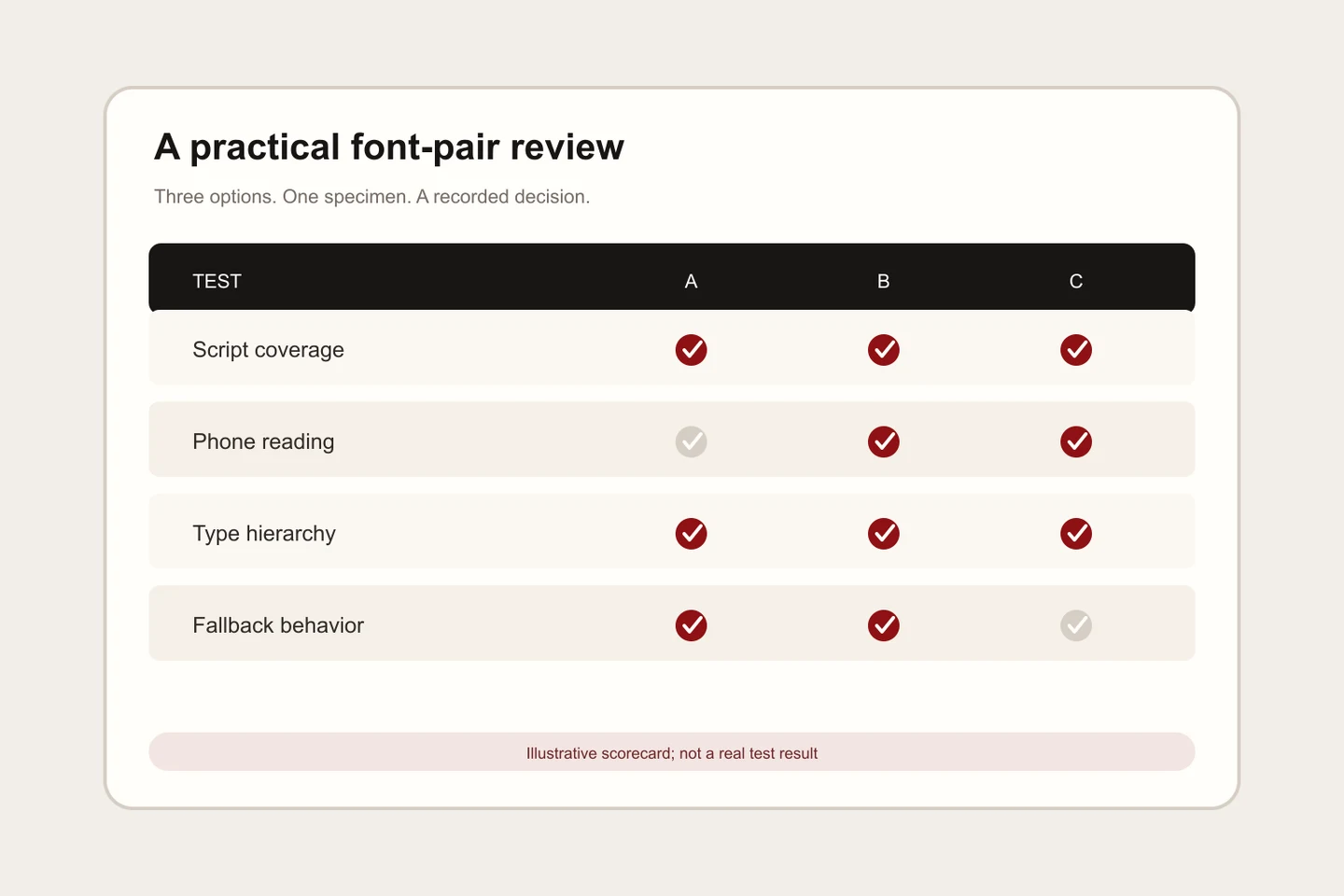
Score each pair from 1 to 5 against your own acceptance criteria. This is an illustrative project tool, not a measured industry benchmark or an objective font-quality score. Give more weight to the requirements that matter to your site: long Arabic reading, brand tone, form legibility, available weights, loading and licensing. A low score on Arabic glyph support or a required character is a disqualifier, not something a beautiful Latin heading can compensate for.
For example, a Saudi consultancy could compare three pairs against Arabic service paragraphs, English case-study headings, a mixed-language contact form and a mobile consultation button. The team should record which specimen failed and why, choose the pair that meets every must-have, and keep the other pairings as rejected options. No font choice guarantees enquiries, accessibility conformance or better search positions.
Scroll the table sideways to read every column.
| Check | What to inspect | Decision rule |
|---|---|---|
| Script coverage | Arabic and Latin characters, numerals and punctuation used on the site | Reject missing or substituted required glyphs |
| Reading | A real paragraph and dense service or product details on a phone | Both languages stay comfortable without zooming |
| Hierarchy | Heading, body, label and button roles | Weights and apparent sizes remain distinct in both scripts |
| Brand fit | Tone beside the current logo, colours and imagery | Pair supports the intended voice without competing |
| Implementation | Required files, weights, fallback and license for the intended use | Approve only after developer and rights checks |
Check the exact font files, license and loading behavior
A font available in a directory or design tool is not automatically cleared for every web use. Check the exact family’s license and any conditions for self-hosting, embedding, modification or redistribution. The Google Fonts repository explains that individual family folders include licensing information and that different families may use different licenses; verify the license shipped with the exact files you intend to use.
Ask the developer which weights and character subsets will actually ship, whether the site loads the necessary Arabic glyphs, and what visitors see before the web font arrives or if it fails. CSS font-family values form an ordered fallback list and font selection can happen per character, so an English-first font may still fall back for Arabic glyphs. Test the rendered result, not only the CSS declaration. Avoid loading many unused weights just to make a font menu look comprehensive.
References: W3C: Structural markup and right-to-left text in HTML · MDN: font-family CSS property
Review the same typography across your Saudi customer journey
A useful review follows the customer’s real tasks, not a list of city keywords. A local-pickup business serving Hofuf and Mubarraz within Al Ahsa can test Arabic pickup instructions beside Latin map labels or vehicle details. A Dammam or Khobar supplier can test bilingual technical specifications and quotation forms. A Riyadh or Jeddah service firm can compare long service descriptions and contact actions. Confirm actual service and delivery coverage with the business before publishing any location promise.
Biaway works online with businesses in Saudi Arabia; this does not mean it has physical branches in these cities. A remote project can still review the pages and content that matter to customers in Al Ahsa, Hofuf, Mubarraz, Dammam, Khobar, Riyadh and Jeddah. The project brief should state which locations and customer tasks are relevant rather than adding place names to every heading.
Approve typography only after the rendered site passes
Approve the pair after the actual site build is available in both languages. Test the smallest supported screen and a desktop layout, wait for the font request to settle, and then repeat once with that font unavailable. Check the main navigation, representative long content, forms, tables, numbers and calls to action. A design mock-up is not a substitute for checking the delivered font files and responsive page.
Keep a small implementation record: selected family names, required weights, source and license, fallback stack, language-specific application rules, tested pages and any known exceptions. If a future update changes the font or adds a language, repeat the specimen. For help scoping the full bilingual site rather than choosing a typeface in isolation, compare the page structure and web-design scope with Biaway before agreeing deliverables.
- Collect representative Arabic, English and mixed-script content without personal data.
- Compare three candidate pairs in the same real page components and phone width.
- Score must-have coverage, reading, hierarchy, brand fit, file weight and license.
- Inspect the production-like render in English, Arabic RTL and font-failure fallback.
- Record the chosen families, weights, files, license and acceptance screenshots.
How this guide was prepared
Prepared with AI assistance, with platform and accessibility claims checked against the primary sources below at publication. The planning frameworks are Biaway’s editorial recommendations. Examples labelled illustrative are not client stories or measured results. Platform features and requirements can change.
Your questions.
01Should a Saudi bilingual website use the same font for Arabic and English?
It can use one family if both scripts and the needed weights work well, or two complementary families. Compare real Arabic and English content in the same interface; neither approach is universally best.
02Can I pick an Arabic font from its sample page alone?
No. Check long paragraphs, navigation, forms, numerals and mixed Arabic-English text at the actual phone width, then verify the rendered site and fallback.
03Does choosing the right Arabic font fix RTL layout problems?
No. Language declarations and text direction are separate. The document and components still need correct language, direction and mixed-script handling.
04Does a particular font improve Google rankings?
This guide makes no ranking claim. Select fonts for script coverage, readability, brand fit, licensing and reliable implementation; typography alone does not guarantee search positions.