How do you write useful Arabic and English product descriptions?
Help the buyer understand the actual product and choose the right version. A shared fact sheet and a bilingual review process produce more useful descriptions than generic praise or repeated keywords.
In this guide
Describe the buying decision before adding keywords
A useful product description explains what the item is, which version the buyer is viewing, the facts needed to judge suitability and any relevant limits. Arabic and English versions should make the same promise in natural language. Repeating 'best quality' or a list of Saudi cities does not tell a shopper whether the product fits their shelf, device or intended use.
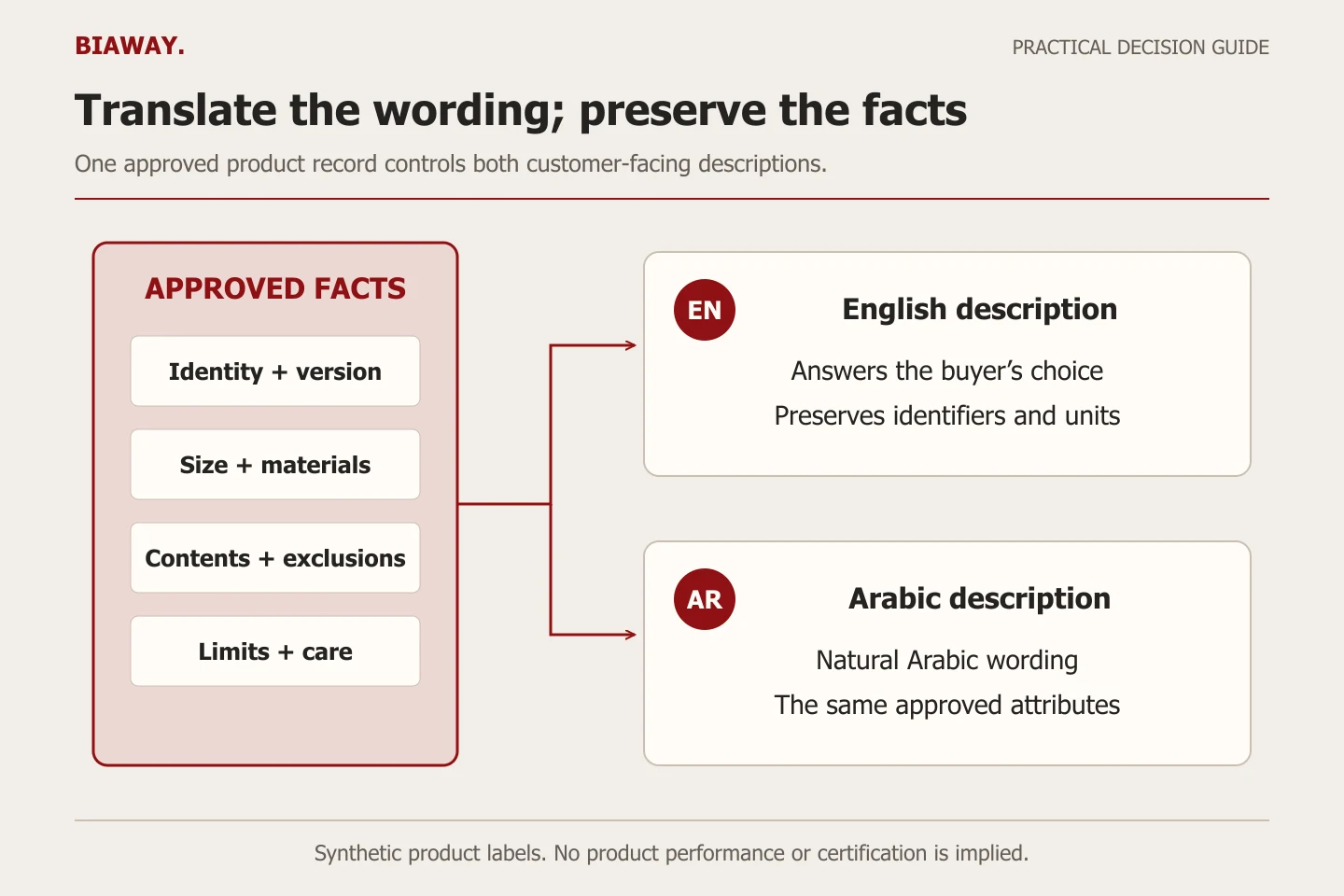
Start from approved information: the product itself, a reliable specification sheet, verified measurements and the merchant's actual offer. The writer's job is to make those facts understandable. If a material, compatibility claim or included accessory is unknown, ask the owner; do not fill the gap with plausible-sounding copy.
Create one fact sheet that both languages share
Give each product or variant a stable reference, then record the facts that matter for its category. An organiser may need dimensions and included pieces; an electrical item may need verified compatibility and technical details. Do not reuse the same specification labels for every category just to make the page look complete.
Use the following original approval framework before drafting. Keep the source and approver in the private working record so an update can be checked later.
Scroll the table sideways to read every column.
| Buyer question | Content to prepare | Verification needed |
|---|---|---|
| What exactly is this? | Product type, model and selected version | Approved catalogue reference |
| Will it fit my use? | Dimensions, materials or supported applications | Measured or supplier-approved facts |
| What comes with it? | Included items and relevant exclusions | Actual package contents |
| What differs between options? | Variant-specific differences | Approved variant table |
| What should I know before ordering? | Important limits and care information | Current owner-approved instructions |
| Where is it available? | Separate delivery/collection information | Real fulfilment policy |
Replace vague praise with a concrete example
Illustrative example only: a fictional desktop organiser is approved as sand-coloured, 24 cm wide, 12 cm deep and 10 cm high, with three compartments and no included stationery. Those facts can support useful copy without inventing durability tests, environmental claims or customer results.
Weak version: 'The finest organiser with premium quality for every office.' More useful English version: 'Sand desktop organiser with three compartments, measuring 24 × 12 × 10 cm. Use it to separate small desk items; stationery shown in the image is not included. Check the dimensions against the space where you plan to place it.'
Natural Arabic counterpart: 'منظّم مكتب بلون رملي بثلاث حجرات، بأبعاد 24 × 12 × 10 سم. يساعد على فصل الأدوات المكتبية الصغيرة، ولا تشمل العبوة الأدوات الظاهرة في الصورة. راجع الأبعاد مقارنة بالمساحة التي ستضعه فيها.' These are demonstration texts for an invented item, not approved copy for a real product. The practical improvement is the information supplied, not a claimed conversion uplift.
Translate the decision, while preserving identifiers and units
Agree Arabic terminology for the product category and use it consistently across titles, options and navigation. Keep model references, SKUs and verified numerical specifications aligned between languages. Review units explicitly: a translated label must not turn centimetres into millimetres or a pack of two into two separate orders.
Have someone who understands the product check both versions against the shared fact sheet. Ask them to identify the item, select a variant and explain what is included. This is a stronger acceptance test than asking whether the text 'sounds good'. Arabic may need a different sentence order to read naturally; it does not need a different product promise.
Mixed Arabic text, Latin identifiers and measurements also need visual review. W3C explains that bidirectional content can require appropriate isolation and direction handling. The implementer should check the rendered page, options and order summary, not insert arbitrary invisible characters into the product database as an untested fix.
References: W3C: bidirectional text and Unicode controls
Keep page copy and product-feed fields distinct
Google Merchant Center's description guidance concerns a specific product-data field. It calls for product-focused information consistent with the landing page and separates promotional or shipping information into other attributes. That does not mean a website must hide delivery conditions: put them in the appropriate customer-facing section and keep them accurate.
If generative AI creates descriptions submitted to Merchant Center, Google's current guidance requires the structured_description attribute with digital_source_type set to trained_algorithmic_media. Check the platform or feed integration's support rather than assuming that an ordinary website paragraph automatically satisfies the feed requirement. This is a feed implementation issue, not an extra invented HTML meta tag.
References: Google Merchant Center: description and structured_description
Make Saudi delivery context useful without stuffing the description
For a hypothetical Saudi Arabia store, an organiser collected in Hofuf or Mubarraz within Al Ahsa has the same dimensions as one delivered to Dammam or Khobar. Customers ordering for Riyadh and Jeddah need accurate shipping availability, preparation information and any product restrictions, but those details should not be repeated as city keywords inside every specification sentence.
Keep a clear delivery or collection section beside the buying information and link to the actual policy where appropriate. If the merchant cannot serve a destination, make that limitation discoverable before purchase. Biaway can organise this content and the website remotely; the merchant supplies the real coverage and product facts, and no local branch or client relationship is implied by this example.
Approve the published page, not just a writing document
Review the title, selected variant, description, images, price and delivery information together. A correct paragraph can still mislead if the photo shows an accessory that is not included or an option label selects another size. Check mobile reading, Arabic wrapping and whether essential information remains available before checkout.
Create a short change record for each update: what changed, which source approved it, and which language or feed fields also need revision. When a specification changes, update both languages rather than leaving the English page as the accidental source of truth. Judge improvement through fewer identifiable information gaps and observed customer questions, not a promised ranking position.
Biaway's catalogue checked on 16 October 2026 lists SAR 700 one-time ecommerce setup with up to 25 products, including descriptions and supplied images within scope. Confirm the required languages, the source of product facts and the amount of content work in the proposal. Photography, unsupported product claims and unlimited catalogue writing should not be assumed.
References: Biaway: ecommerce catalogue content scope
How this guide was prepared
Prepared with AI assistance, with platform and accessibility claims checked against the primary sources below at publication. The planning frameworks are Biaway’s editorial recommendations. Examples labelled illustrative are not client stories or measured results. Platform features and requirements can change.
Your questions.
01What is a product description?
It is the customer-facing explanation of the product, its relevant characteristics, selected version and practical limits. A useful description helps a buyer decide whether the actual item fits the intended use.
02How do I write a product description?
Start with verified facts, answer the buyer's main suitability questions, explain what is included and review the text alongside images and options. Remove unsupported praise and unresolved assumptions.
03Should Arabic and English descriptions be literal translations?
They should preserve the same approved facts and commercial promise, but use natural wording in each language. Check terminology, numbers, units and variant names against one shared reference.
04Can AI write the descriptions?
It can help draft from supplied facts, but the business must verify the result and the real product. If AI-created text is submitted to Google Merchant Center, follow its current structured-description requirements through the actual feed integration.