How should you name tracking links for Arabic and English campaigns?

A useful campaign link helps your team recognise the source and purpose of a measured visit. Use one documented naming convention across Arabic and English content, then test the actual destination. This guide includes a working dictionary, bilingual examples and a link-approval checklist.
In this guide
Use one campaign dictionary for both languages
A campaign link should identify the marketing activity that brought someone to your website without turning every spelling variation into a separate campaign. For an Arabic and English offer, keep the shared campaign identity stable and use a documented field to distinguish the creative or language version. The destination page must still match the advertisement’s language and promise.
UTM parameters are labels attached to a destination URL. Google Analytics uses them in acquisition reporting; their values are case-sensitive. Google, google and a misspelled variant can therefore fragment a report. Choose a simple convention the team can follow, then write the allowed values down. Lowercase labels are a practical working choice, not proof that English identifiers are required for Arabic marketing.
References: Google Analytics: campaign URL builders and UTM conventions
Decide what each field means before building links
The original register below is a suggested team convention. Its purpose is to keep responsibilities and meanings stable, not to create an official taxonomy for every platform. Google recommends setting source, medium and campaign consistently. Use content to distinguish a creative when useful, and keep campaign IDs stable if your reporting process uses them.
Do not use the source field for a city in one link and a social network in another. Do not make the campaign field a free-form note. If the agency and owner need different internal descriptions, keep those in the register beside the URL rather than placing all of them in the public query string.
Scroll the table sideways to read every column.
| Field | Illustrative rule | Common mistake |
|---|---|---|
| utm_source | One approved platform label, such as instagram | Mixing instagram, insta and Instagram |
| utm_medium | One agreed channel label, such as social | Changing the medium for every post |
| utm_campaign | Stable initiative, such as autumn_website_brief | Using a new name for the translated version |
| utm_content | Creative and language, such as checklist_ar | Placing a customer’s name in the value |
| utm_id | Optional stable internal campaign identifier | Reusing the ID for unrelated campaigns |
| Destination | The actual relevant Arabic or English page | Sending both languages to an unrelated homepage |
References: Google Analytics: campaign URL builders and UTM conventions · Google Analytics: avoid personal information in URLs and events
Keep the offer together and the language variations visible
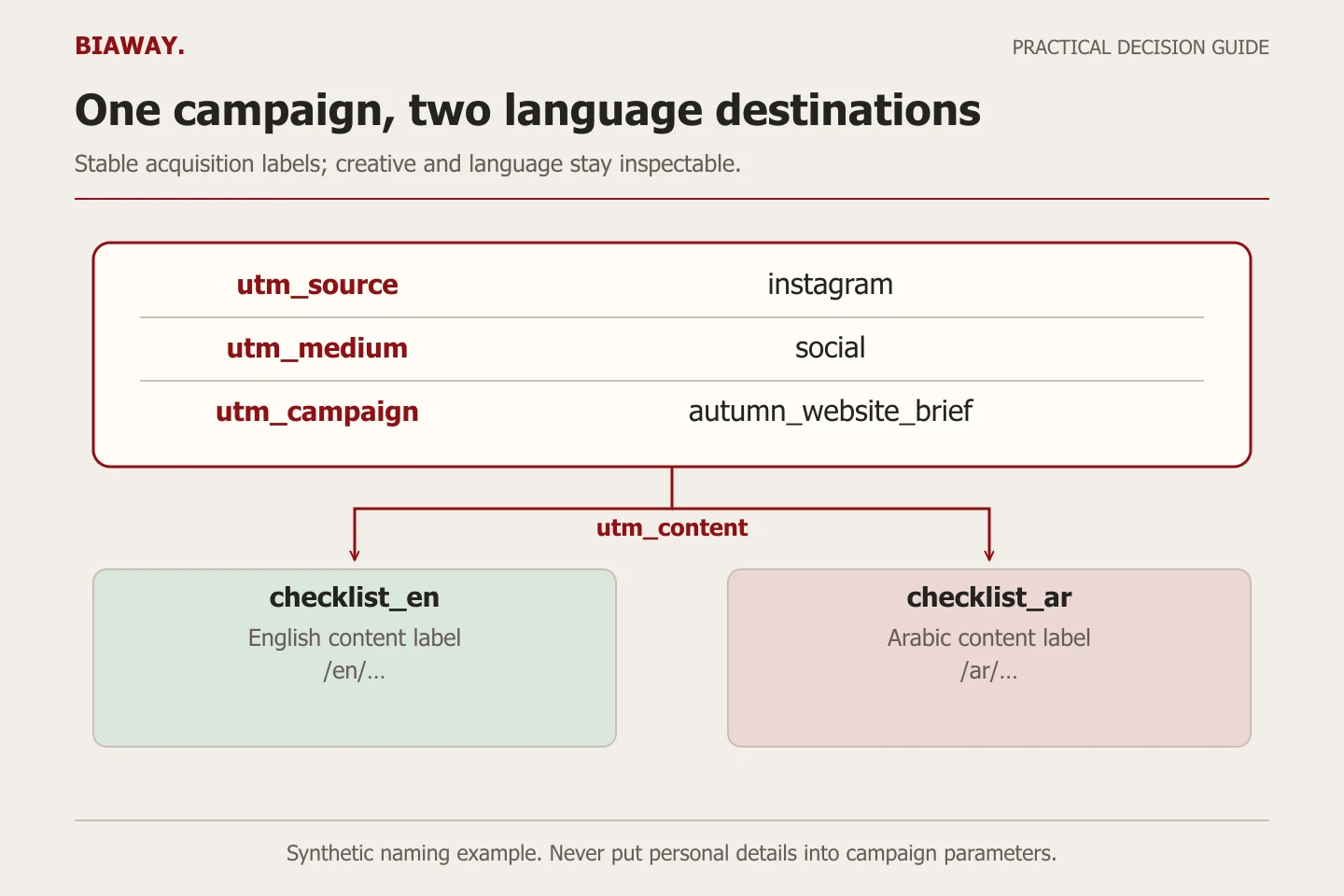
Consider a hypothetical Saudi service business promoting one website-brief checklist. Its Arabic and English posts support the same initiative. The following example keeps that initiative together while separating the two creatives. These are illustrative example.com addresses, not live Biaway campaign links or evidence that any campaign was published.
Arabic destination: https://example.com/ar/brief/?utm_source=instagram&utm_medium=social&utm_campaign=autumn_website_brief&utm_content=checklist_ar. English destination: https://example.com/en/brief/?utm_source=instagram&utm_medium=social&utm_campaign=autumn_website_brief&utm_content=checklist_en.
Keep a human-readable Arabic campaign description in the planning sheet if that helps the team. Do not improvise a supposed standard utm_language parameter and assume it appears automatically in reports. If a custom language parameter is needed, its collection and reporting must be deliberately implemented and tested. Often the page path, page-language event and documented content value already answer the practical question.
Use campaign labels only where they describe acquisition
Prepare tagged links for appropriate external marketing placements, such as a social post linking to the relevant website page. Do not label every navigation link inside the website as a new campaign. Internal navigation needs its own interaction measurement; attaching acquisition labels to it can make campaign interpretation harder.
Review existing Google Ads auto-tagging and account linking before adding manual labels to paid-search destinations. Auto-tagging and manual campaign tagging have different roles and precedence rules; do not replace working identifiers simply to make all links look alike. Keep a record of the chosen method and ask the measurement owner to test it.
Likewise, a URL shortener or redirect service is a delivery method, not proof that parameters reach the final page. A link can open correctly while losing its campaign information. Check the final destination, language and permitted labels after every redirect, using a safe test path rather than clicking your own paid advertisement.
References: Google Analytics: manual tagging and auto-tagging
Approve a link with a repeatable test
Assign someone to create the link and someone to check it before scheduling. A small register should contain the owner, planned placement, final destination, campaign values, language, creation date and test result. Record changes rather than silently editing a link after a report has already used it.
Use synthetic or public campaign labels only. URLs can be copied, logged or forwarded, so they are the wrong place for customer names, email addresses, phone numbers or private order details. Test with your actual consent arrangement: refusal of optional analytics should not prevent the page from opening, and a working page does not imply that an analytics event was collected.
- Choose the approved destination for the actual offer and language; check it without tracking parameters first.
- Build the tagged URL from the dictionary and check for missing, duplicate or incorrectly cased parameters.
- Open it through the intended placement or a safe equivalent, then inspect the final URL after redirects.
- Confirm that the page language, headline and contact action match the promised offer.
- In an authorised diagnostic environment, check which permitted campaign values reach measurement when consent allows it.
- Record pass, fail or not verified, and retain the tested URL with the scheduled content.
References: Google Analytics: avoid personal information in URLs and events
Use location labels only when the campaign actually differs
Suppose a business in Hofuf and Mubarraz within Al Ahsa offers collection locally, delivery to Dammam and Khobar under stated conditions, and a separate remote service for Riyadh and Jeddah. Those are potentially different offers and fulfilment rules. The register should explain the difference before deciding whether separate campaign identities are useful.
For one online offer available throughout Saudi Arabia, inserting every city into every URL adds clutter without creating meaningful measurement. Biaway works online; a national campaign does not imply branches in the named cities. Use location distinctions when they change the advertised service or a real reporting decision, not as an attempt to influence organic rankings through UTM values.
Read the tagged report as observed traffic, not complete attribution
After the relevant reporting delay, inspect the matching acquisition dimensions and a complete date range. Look for fragmented labels, unexpected not-set values and a destination that behaves differently by language. Google’s campaign guidance identifies session source, medium and campaign in Traffic acquisition; check the current report configuration instead of assuming every custom label appears everywhere.
Campaign labels tell you how measured visits are classified. They do not reveal every person who saw a post, every private message that followed, or whether the marketing caused a sale. Consent choices, browser restrictions, shared links and later visits can limit interpretation. Compare appropriate website actions with the business’s separately maintained enquiry record.
Before requesting more content, fix a broken naming process that makes existing results unreadable. Biaway can discuss the link register alongside social or advertising scope, but confirm any custom analytics implementation explicitly. The useful deliverable is a tested, explainable convention that the next person can maintain.
References: Google Analytics: campaign URL builders and UTM conventions
How this guide was prepared
Prepared with AI assistance, with platform and accessibility claims checked against the primary sources below at publication. The planning frameworks are Biaway’s editorial recommendations. Examples labelled illustrative are not client stories or measured results. Platform features and requirements can change.
Your questions.
01Must campaign values be written in English?
No. The main requirement is a consistent, tested convention. Simple lowercase identifiers can make handover easier, while Arabic descriptions remain in the planning register. Test encoding and reporting for the values you actually use.
02Should Arabic and English posts always have different campaign names?
Not when they support the same initiative. A stable campaign name and a documented creative or language distinction can keep the initiative together. Separate names are useful when the underlying offers or reporting decisions truly differ.
03Will UTM parameters improve Google rankings?
They are measurement labels, not an organic ranking tactic. Keep canonical page URLs and useful content clear; do not stuff service or city keywords into tracking values.
04Can I put a prospect’s email in a campaign link?
No. Do not put personal information in public URLs or analytics parameters. Use non-personal campaign labels and keep customer details in the authorised business system.