Broad, phrase or exact: which keyword match type fits your campaign?

Choose keyword matching around the searches you can serve and the outcome you can measure. Exact match offers tighter steering, phrase match covers the keyword's meaning, and broad match can reach related searches. None of them substitutes for a clear offer, suitable landing page or trustworthy conversion setup. Start with the decision you need to make, then choose how much exploration the campaign can support.
In this guide
Know what a match type actually controls
Google's three keyword match types describe how a search can relate to a positive keyword. A matching query makes an ad eligible to compete; it does not guarantee an impression or a sale. Keep positive matching separate from negative-keyword rules.
The comparison below is a definition guide, not a performance ranking. More reach can be useful if the additional enquiries fit your offer, while tighter matching can still attract unsuitable buyers.
Scroll the table sideways to read every column.
| Type and syntax | Search relationship | Question for the business |
|---|---|---|
| Broad: website design | Related searches, potentially beyond the keyword's direct meaning | Can measurement and review distinguish valuable expansion? |
| Phrase: "website design" | Searches that include the keyword's meaning | Does the landing page cover the meaningful variations? |
| Exact: [website design] | The same meaning or intent | Is this a sufficiently clear service intent? |
References: Google Ads: keyword matching options
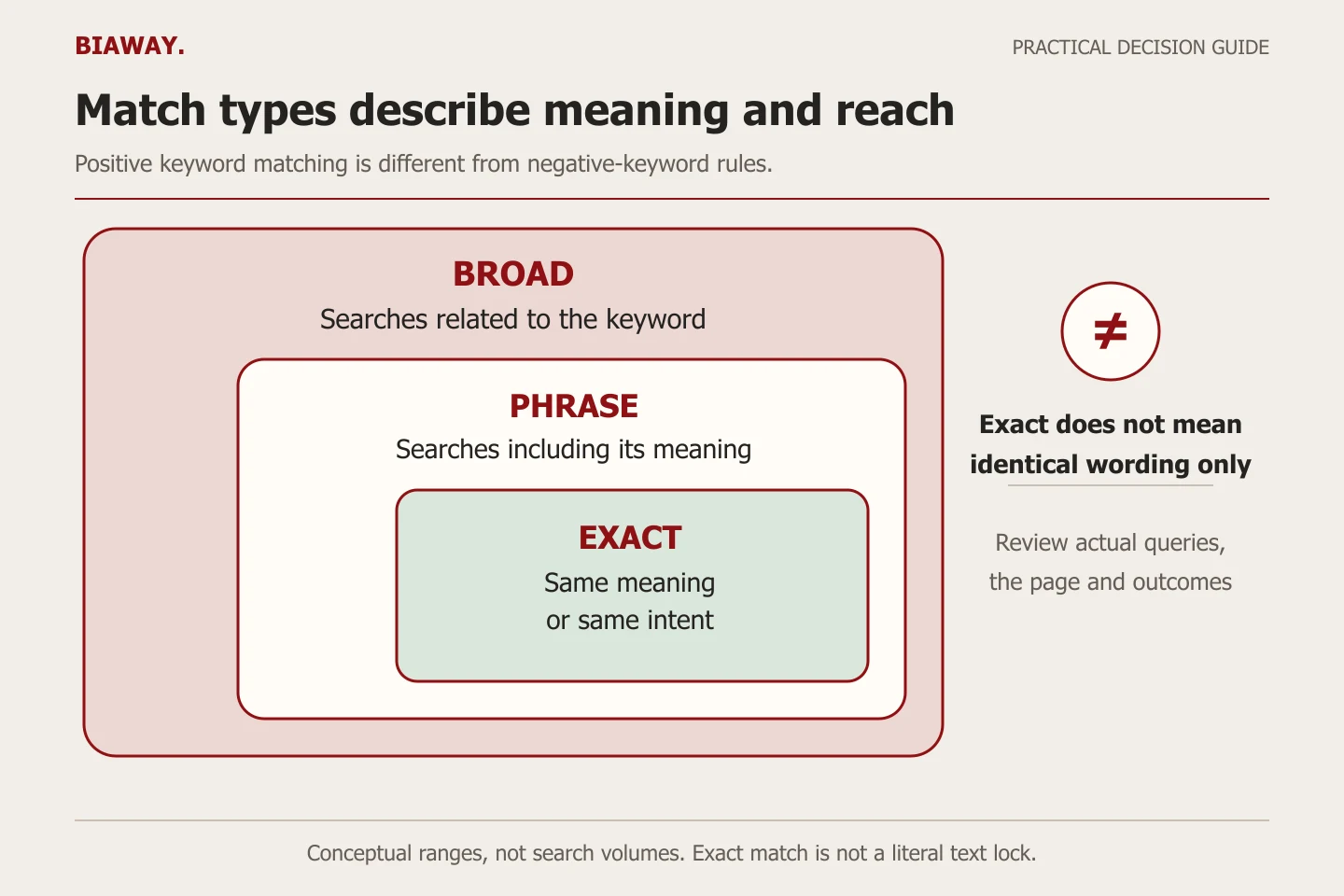
Do not treat exact match as a literal text lock
Close variants can connect positive keywords with related wording; exact match is not limited to an identical string. Google documents variants such as reordered words and equivalent intent, with support that varies by language and variant type. This is why an exact-match campaign still needs query review.
For an Arabic and English offer, inspect the language people actually use and the page they reach. Do not create hundreds of spelling combinations by habit, but also do not assume an English keyword plan automatically provides the Arabic message, landing page and sales response the customer needs.
References: Google Ads: keyword close variants
Decide how much exploration the business can support
Biaway's editorial starting point for a new, narrowly defined service is a small set of clear buyer intents with a relevant landing page and an agreed review process. This is a workflow choice, not a claim that one match type always produces cheaper leads. A business with verified outcomes and useful learning data may be ready to test a wider reach.
Google recommends Smart Bidding with broad match. Before expanding, check what the campaign is learning from. A repeated button click, a test submission and a genuine qualified enquiry are not interchangeable business outcomes. In standard goals, primary actions affect bidding only when their goal is used; secondary actions are generally observational, with a custom-goal exception.
- Define the service and the enquiries you will reject.
- Verify a completed action rather than assuming every interaction is a lead.
- Assign someone to review query intent and lead quality.
- Agree a test budget and review criteria that the business can afford.
References: Google Ads: keyword matching options · Google Ads: primary and secondary conversion actions
Worked example: a business website campaign
Hypothetical example, not a Biaway client result: a studio builds business websites but does not sell courses or recruit developers. Its landing page explains project scope and asks for the business type, required pages and languages. The table is a proposed review plan; it does not predict Google's exact matching or auction outcomes.
Start by recording what qualifies as a useful enquiry. Then compare actual search terms and the requests they produce. An apparently relevant phrase can still bring the wrong budget or deliverable, while a less obvious wording may describe a suitable project.
Scroll the table sideways to read every column.
| Buyer intent | Initial test idea | Evidence to review |
|---|---|---|
| A company looking to commission a website | A focused exact or phrase keyword | Does the query and enquiry describe a business project? |
| A broader related website need | A separate, documented broad-match test when ready | Which additional intents appear and are they qualified? |
| Someone seeking a design course | Document the training exclusion | Is training outside every affected campaign? |
| Someone comparing project prices | Use a page that explains scope and costs | Does the enquiry describe enough scope to quote? |
Run a test you can interpret
Write the hypothesis before the change: for example, broader matching may find additional suitable website projects at an acceptable cost per qualified enquiry. Record the old match settings, landing page, goal and budget. If you change them all at once, the result will not isolate keyword matching.
Choose a review period long enough for your usual enquiry and qualification delay. Keep the same definition of a qualified lead throughout it. Compare spend, visible query relevance, qualified requests and the reasons rejected leads failed; do not choose a winner from CTR alone.
The search terms report's match-type column describes the relationship between a query and the keyword that triggered it. It is not a substitute for reading the keyword's configured setting. Record both so a report label is not mistaken for an unplanned account change.
- Record the baseline and exact change.
- Check that conversion recording still works after implementation.
- Review visible queries with the sales team's qualification notes.
- Keep, narrow or reverse the change based on the agreed criteria.
References: Google Ads: search terms report keyword and match-type columns
Use geography to define fulfilment, not to multiply keywords
A website provider serving Saudi Arabia online can use the same decision framework for Hofuf and Mubarraz within Al Ahsa, then assess enquiries from Dammam and Khobar against the actual project requirements. Riyadh and Jeddah buyers may need different meeting times or stakeholder coordination, but that does not automatically justify duplicate keyword sets for every city. Add a location distinction when delivery, on-site work or the offer really changes. Biaway's online coverage is a service arrangement, not evidence of local offices or city-specific advertising prices.
Give your manager a decision brief
Ask the campaign manager to explain the chosen match types, the excluded intents, the landing page and the conversion action used to assess results. A list of keywords is incomplete without those relationships. Keep a short record of why each major change was made.
Biaway's published advertising-management scope includes targeting, campaign structure, ad copy, monitoring and basic optimisation. The 400 SAR monthly management fee is separate from advertising spend. Agree the test scope and reporting detail before committing media money; no match type guarantees sales.
References: Biaway: advertising management scope
How this guide was prepared
Prepared with AI assistance, with platform and accessibility claims checked against the primary sources below at publication. The planning frameworks are Biaway’s editorial recommendations. Examples labelled illustrative are not client stories or measured results. Platform features and requirements can change.
Your questions.
01Is exact match the safest option for every small budget?
It offers tighter steering, but it is not a guarantee of relevant enquiries or low cost. The offer, search intent, landing page and conversion definition still matter. Choose a focused starting point and evaluate the real requests.
02Should every keyword appear in all three match types?
Not by default. Avoid copying the same list into every option without a clear test or management reason. Decide what question each setup answers and how you will interpret its results.
03Can I use broad match with unreliable conversion tracking?
Fix the measurement and business goal before asking automation to find more of that outcome. Google recommends Smart Bidding with broad match; a weak signal can make the resulting performance difficult to assess.
04Why did a search appear that is not written exactly like my keyword?
Positive matching can use meaning and close variants. Check the query, the matching keyword and the campaign configuration. Exact match is not an instruction to accept only one literal spelling.