Search or Performance Max: choose the job before the campaign type

A focused Search campaign can help you organise advertising around explicit buyer searches. Performance Max can pursue conversion goals across several Google channels. The right starting point depends on your offer, measurement and creative resources, not the campaign name. Choose one clear business question first: capture a known service intent, or test broader reach beyond it.
In this guide
Compare what each campaign is designed to do
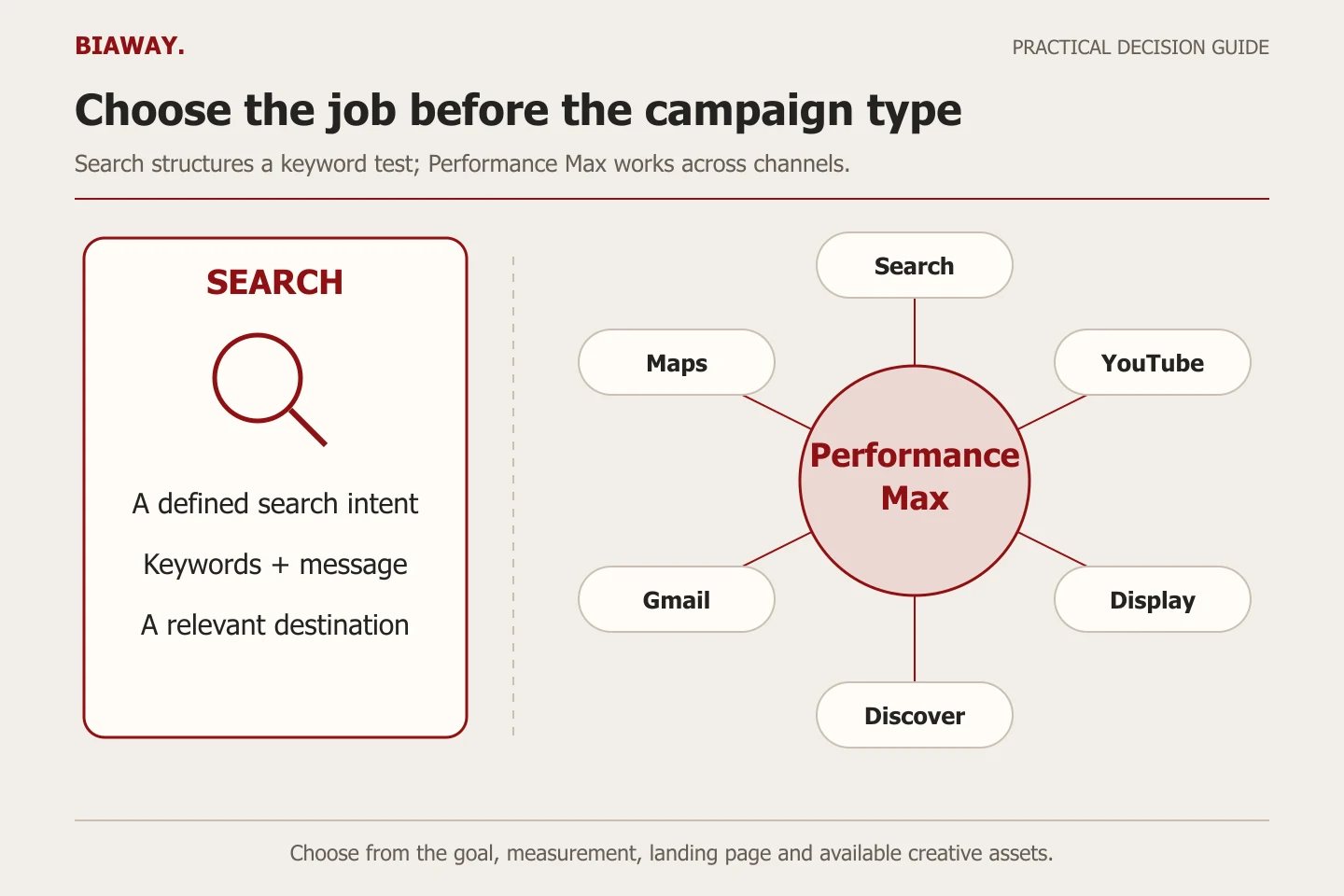
Keyword-based Search gives you an explicit keyword structure for search demand. Performance Max is goal-based and can serve across Search, YouTube, Display, Discover, Gmail and Maps, using the assets, goals and settings you provide. Google describes it as complementary to keyword-based Search.
The practical distinction is the management question. A narrowly defined search test is easier to discuss in terms of buyer queries and the page answering them. A cross-channel campaign requires a credible outcome signal and materials that make sense in more than one placement.
Scroll the table sideways to read every column.
| Decision | Keyword-based Search | Performance Max |
|---|---|---|
| Primary planning unit | Search intent, keywords and relevant ads | Conversion goal, asset groups and cross-channel reach |
| Creative preparation | A clear offer and relevant search message | A broader set of suitable text and visual assets |
| Review focus | Query relevance and qualified enquiries | Business outcome quality and where the campaign contributes |
| Reason to choose | A specific service-search question to test | A measured case for exploring additional channels |
References: Google Ads: Performance Max campaigns · Google Ads: keyword matching options
Check readiness before adding more reach
First make the conversion definition usable. If a campaign is judged by every contact-button click, a rise in recorded actions may simply mean more button use. Agree which action indicates a real enquiry and how staff will classify it after contact. Keep a small reconciliation sheet between ad reporting and the business's own records.
Next assess the destination and materials. Does the page explain the same service as the ad? Can a customer understand delivery, language and the next step on a phone? Are images approved and relevant? If those basics are incomplete, choosing a more automated campaign does not resolve the underlying gap.
- One written definition of an acceptable business outcome.
- A landing page that fulfils the advertised promise.
- A reliable response process for incoming requests.
- Approved creative materials appropriate to the selected channels.
- A budget and review plan that can tolerate an inconclusive test.
Worked example: a service company with a narrow first offer
Hypothetical example, not a Biaway client result: a company sells maintenance contracts for commercial equipment. It has one useful enquiry page and can distinguish serviceable businesses from domestic repair requests. It has limited approved visual material and wants to learn whether buyers searching for that contract will request a quotation.
A focused Search test is a reasonable editorial starting point because it addresses that specific question. Once the team can verify enquiry quality, respond consistently and prepare suitable assets, it can write a separate Performance Max test hypothesis. That sequence is a decision framework, not evidence that Search will outperform Performance Max.
Scroll the table sideways to read every column.
| Observed condition in the example | Immediate decision | Evidence needed before expansion |
|---|---|---|
| One clearly defined contract offer | Keep the first test focused | Queries and requests match that contract. |
| Domestic and commercial leads need separating | Add qualification to the enquiry process | Staff consistently record the type of request. |
| Few approved visual assets | Plan creative production before broader channels | Materials accurately depict the service. |
| No reliable view of accepted enquiries yet | Reconcile tracking and business records | The reported action corresponds to a usable lead. |
Do not assume the two campaigns divide search traffic neatly
The same search may be eligible for more than one campaign. Under Google's prioritisation rules, an eligible exact-match Search keyword identical to the query receives priority over Performance Max. Other cases depend on further matching, relevance and Ad Rank rules. Eligibility matters: targeting, disapprovals, low-volume status or budget restrictions can change what can serve.
Therefore, “Search always wins” is too broad. Review the actual query and account configuration before interpreting overlap. Also separate brand demand from broader acquisition when judging a test; familiar-brand enquiries answer a different business question from enquiries by people discovering the offer.
References: Google Ads: ad and asset-group prioritisation and exceptions
Evaluate the contribution, not the cheapest-looking total
Write a test brief with the offer, audience served, conversion definition, budget allocation and decision date. Save a baseline before adding a campaign. If you simultaneously redesign the page, change the goal and widen the geography, the result will not tell you which change caused the difference.
Compare qualified enquiries and their progress using the same rules. A campaign with more raw forms may contain duplicates, unsuitable requests or submissions that the team never reached. Conversely, an apparently costly enquiry may be commercially appropriate. Record the reasons before treating cost per recorded conversion as the whole answer.
Give the review enough time for your normal response and qualification cycle. There is no universal number of days that makes every low-volume test reliable. If evidence is thin, state that uncertainty and decide whether further spending is justified; do not turn a small sample into a performance guarantee.
- Document a baseline and one clear hypothesis.
- Confirm tracking and the sales response process.
- Review suitable and rejected enquiries consistently.
- Record a decision to continue, revise or stop, including what remains unknown.
Keep serviceable locations consistent during the comparison
A service business may support Hofuf and Mubarraz within Al Ahsa differently from Dammam and Khobar if visits or deliveries are required. It may also serve Riyadh and Jeddah through partners, remote work or a different schedule. Write those actual arrangements before treating Saudi Arabia as one campaign audience. During a Search-versus-Performance-Max test, avoid quietly changing the service area and then attributing every difference to the campaign type. Biaway works online; its ability to support advertising across these cities does not establish a physical branch or local fulfilment for the advertiser.
Confirm the work included in the management proposal
Ask whether the proposal covers one campaign type or both, which assets you must supply, who checks conversion quality, and what will be shown in reports. A management fee and the budget paid to Google are separate decisions. Creative production, tracking remediation and broader testing should be discussed explicitly rather than assumed.
Biaway's published scope includes campaign structure, targeting, copy, monitoring and basic optimisation. Reports cover spend, impressions, clicks, CTR, CPC and observations; leads and conversions depend on available tracking. Confirm the specific Search or Performance Max scope before launch, without interpreting a campaign setup as a sales guarantee.
References: Biaway: advertising management scope and reporting
How this guide was prepared
Prepared with AI assistance, with platform and accessibility claims checked against the primary sources below at publication. The planning frameworks are Biaway’s editorial recommendations. Examples labelled illustrative are not client stories or measured results. Platform features and requirements can change.
Your questions.
01Is Performance Max always better than Search?
No campaign label establishes that. The useful comparison depends on the offer, conversion signal, assets, delivery capacity and quality of enquiries. Test a clear business hypothesis and compare equivalent outcomes.
02Can Search and Performance Max run together?
Yes, but do not assume their search traffic is completely separate. Google's eligibility and prioritisation rules affect overlap. Plan the reporting and review brand demand separately where it changes the interpretation.
03Should a new business automatically start with Search?
A focused Search test can be a practical starting point for a clearly searched service, but it is an editorial choice rather than a universal rule. A business with a different offer or stronger cross-channel assets may justify a different plan.
04Does more automation mean less management work?
It changes the work. Someone still needs to define the outcome, supply appropriate assets, check the destination, evaluate lead quality and decide whether the budget is justified.