Should brand searches have a separate Google Ads budget?

Separate own-brand and generic service traffic when you need different budget controls or a clearer view of what each serves. Do not create extra campaigns solely because a template says to. First define which searches belong to your name, what new demand you want to reach and whether the available evidence justifies a split.
In this guide
Define the two jobs before splitting a campaign
An own-brand search names your business or a recognized variant of its name. A generic service search describes a need without naming your business. Both can be commercially useful, but they answer different questions. One may help someone who already knows where they want to go; the other may introduce the business to a person comparing possible suppliers.
Do not confuse this distinction with new versus existing customers. A first-time purchaser may have learned your name through a recommendation, and an existing customer may use a generic query. The search phrase identifies the observable wording, not the complete customer history. Decide whether your present question is spending control, report clarity or additional customer acquisition before prescribing a campaign structure.
Build a small Arabic and English query register
Write the approved brand name in both languages, known transliterations and genuinely observed variants. Then classify available search terms as own-brand, generic service, other named brand or uncertain. Keep ambiguous words unresolved until the context is clear. A common word inside a business name may also occur in an unrelated request.
Use actual reported phrases to review the boundary rather than manufacturing a long list of supposed searches. Note the source, date range and report limitations. Do not assume that every query is visible or that an English name necessarily reveals the visitor’s preferred service language. The relevant advertisement and landing page still need to answer the actual request.
Separate only when the decision needs it
A split can make sense when the owner wants independently reviewable budgets, different destinations or a clear comparison between named-business demand and generic discovery. Write the reason first. If the account has little activity, a structural split may create more administration without answering a useful new question. Reporting analysis can precede a configuration change.
Google provides brand controls whose availability and scope depend on campaign type. Its guidance also cautions against unnecessary restrictions. A campaign called Nonbrand does not enforce a boundary by itself. Inspect its actual brand settings, keywords and exclusions, then examine overlapping campaigns. Keep implementation appropriate to the current interface instead of assuming one recipe applies to every Search or Performance Max configuration.
References: Google Ads: how to steer branded traffic · Google Ads: about brand exclusions
State whether the budgets are independent or shared
The worksheet below uses an invented planning envelope of 3,040 SAR for a full month. Its 608 and 2,432 SAR allocation is arithmetic chosen to illustrate two separately approved purposes. It is not a recommended 20/80 split, a market price, a forecast or a Biaway package. Actual allocation needs your demand evidence, commercial priorities and ability to evaluate requests.
For a simple unchanged average-daily-budget illustration, dividing those monthly amounts by 30.4 gives 20 and 80 SAR. Google documents daily and monthly spending limits rather than treating the average daily amount as a strict daily cap. Check the actual budget type, start date, changes and billing view before applying any plan. Management fees and other project costs are outside this illustrative media envelope.
Scroll the table sideways to read every column.
| Purpose | Illustrative monthly envelope | Decision to approve | Evidence needed |
|---|---|---|---|
| Own-brand searches | 608 SAR | What named-business demand should this serve? | Actual brand queries, enquiry stages and overlap |
| Generic service searches | 2,432 SAR | Which service and buyer need deserve exploration? | Suitable queries, relevant pages and qualified requests |
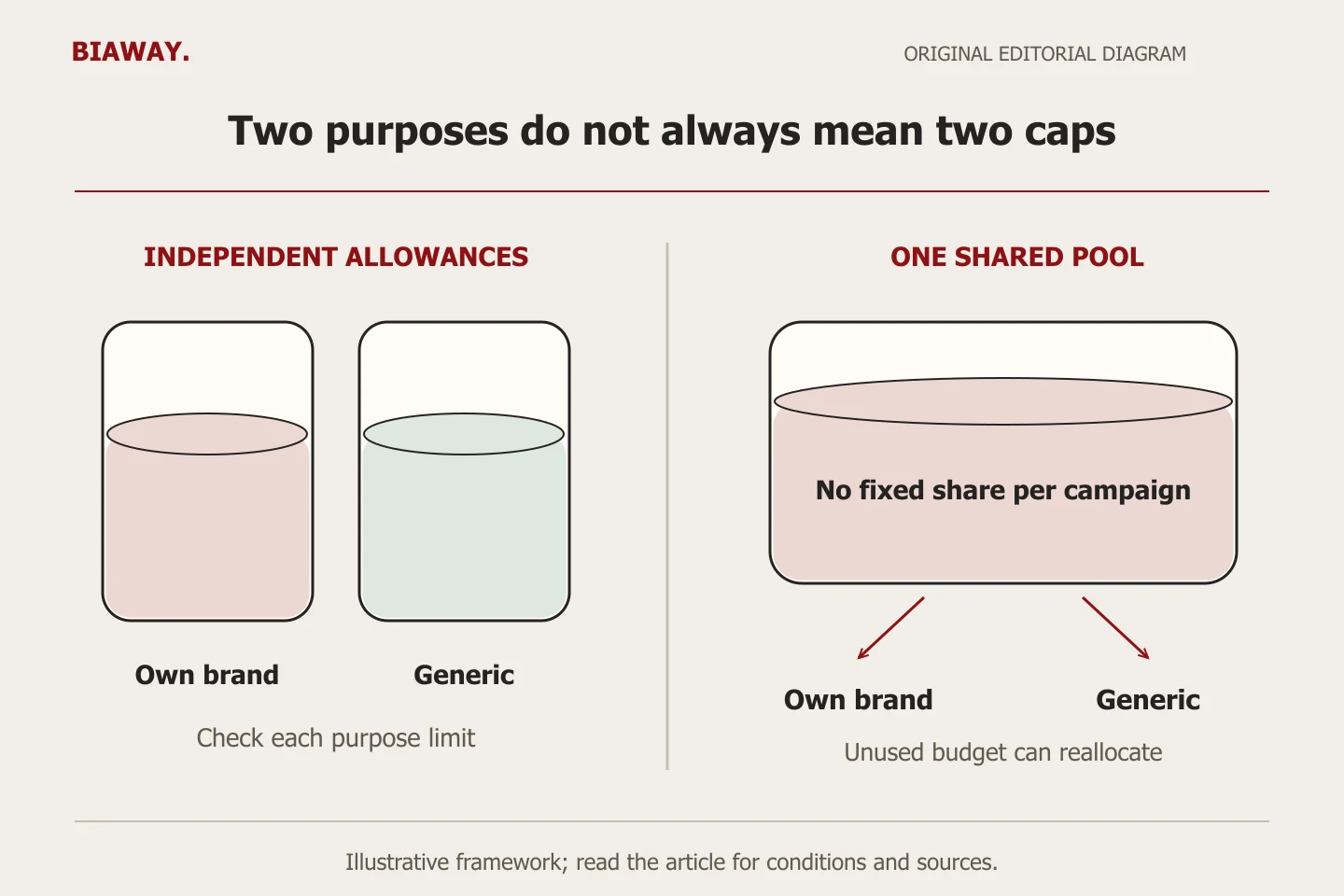
| Combined media plan | 3,040 SAR | Are the two limits independent or one shared pool? | Saved budget associations and actual spend |
| Management and implementation | Not included in the example | What work is separately scoped and approved? | Written scope, responsibilities and agreed fee |
References: Google Ads: budgets overview
A shared pool is a different control
Google describes a shared budget as one average daily budget used by multiple campaigns, with unused budget able to move to another participating campaign. That can be appropriate when the owner wants the group managed as one pool. It does not provide two independently enforced allowances merely because a spreadsheet shows two rows.
If you need a distinct cap for each purpose, ask the manager to demonstrate the actual budget associations and explain the applicable limits. If you prefer a common pool, record that decision and monitor how it is used. Neither arrangement is universally superior. Avoid changing a live budget structure just to match a diagram before reviewing current spend and the consequences of the transition.
References: Google Ads: about shared budgets
Keep the Saudi service decision separate from the brand label
Consider a hypothetical furniture supplier serving Hofuf and Mubarraz within Al Ahsa. A search using its Arabic or English name belongs to the brand review, while a search describing a furniture requirement may belong to the generic service review. Customers in Dammam and Khobar still need accurate delivery or quotation conditions whichever wording they use.
A purchaser in Riyadh or Jeddah might be ordering for a location within the supplier’s real coverage, or might need a service it cannot fulfil. Confirm that distinction through the offer and enquiry handling rather than labelling every distant query unsuitable. Across Saudi Arabia, location names alone are not a reason to create many tiny campaigns. Biaway’s management work is delivered online and does not imply branches in these cities.
Compare like measures without claiming incremental customers
Review spend, observable search wording, measured contact actions, received requests and verified qualified enquiries as separate columns. Use the same definitions and comparable complete reporting periods. A low cost per recorded brand conversion does not prove that the campaign created demand that would otherwise never have reached the business. Nor does a higher generic figure automatically make generic discovery wasteful.
Changes in referrals, organic visibility, promotions or existing-customer activity can affect named-business searches. Report those known influences and leave unmeasured ones unknown. Establishing incremental customer impact requires a defensible evaluation design; a simple brand/nonbrand report is not that proof. Do not switch off a useful route solely because a theoretical argument says everyone would have arrived organically.
Use a dated hypothesis for any allocation change and specify a review condition in advance. For example, you might assess whether a separately controlled generic campaign receives relevant requests without exceeding its approved spend. If evidence remains sparse, keep the result inconclusive rather than declaring a winning percentage or claiming that all generic enquiries are new customers.
Give your manager a reviewable budget brief
Request a bilingual brand-query register, current campaign and budget associations, overlap checks, the reason for any proposed split and the measures used in review. Preserve a copy of the previous configuration and name the approver. Make clear which changes are included and which require separate work on pages, tracking or campaign strategy.
Biaway can discuss this decision within a defined Google Ads management scope. Bring the approved media envelope and real offer rather than an assumed ideal ratio. The goal is to make the purpose and limits of spending understandable, with honest reporting of what is measured and what remains unknown.
How this guide was prepared
Prepared with AI assistance, with platform and accessibility claims checked against the primary sources below at publication. The planning frameworks are Biaway’s editorial recommendations. Examples labelled illustrative are not client stories or measured results. Platform features and requirements can change.
Your questions.
01Should every small business create a separate brand campaign?
No. A separate campaign should answer a genuine control or reporting need. Review the available demand and existing structure before adding complexity.
02Is the example’s 20/80 allocation the recommended split?
No. It is illustrative arithmetic only. No universal brand/nonbrand percentage is established here.
03Does a shared budget protect a fixed allowance for each campaign?
Not in the same way as independent purpose budgets. It is a common pool that can allocate unused budget across participating campaigns.
04Are branded conversions always existing customers?
No. Search wording does not establish customer history. A new buyer may know your name already, while an existing buyer may search generically.